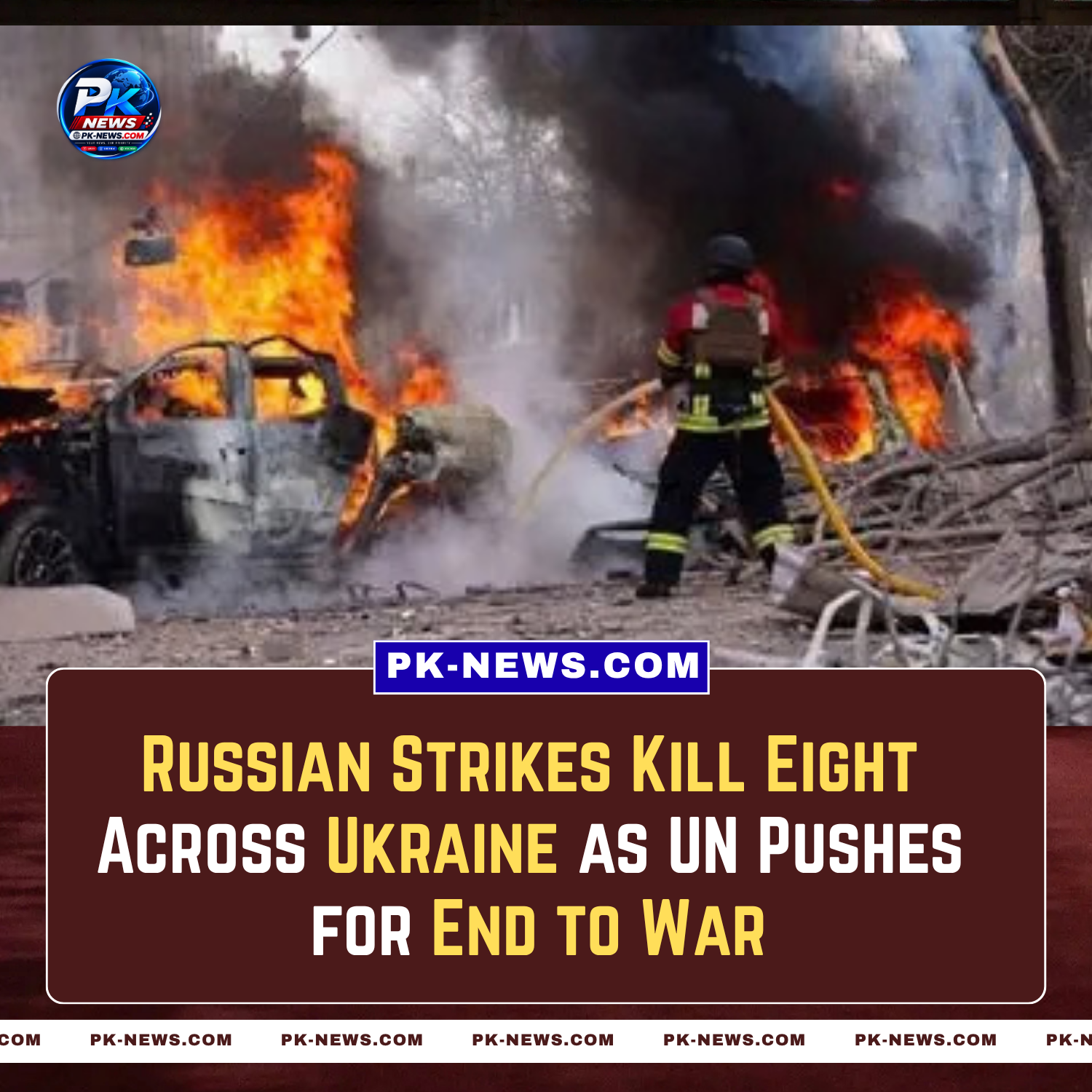
Russian drone and missile attacks killed at least eight people across Ukraine on September 24, according to Ukrainian officials, as fighting continued despite renewed diplomatic efforts at the United Nations. Strikes hit Kyiv and the Kharkiv region, damaging civilian infrastructure, while discussions involving Ukraine, Russia and the United States continued on the sidelines of the UN General Assembly.
Kyiv — September 24, 2026 | PK News
At least eight people were killed in a new wave of Russian drone and missile attacks across Ukraine on September 24, according to Ukrainian officials, as the war continued alongside renewed international efforts to explore ways toward a settlement.
The latest attacks struck areas including Kyiv and the northeastern Kharkiv region, with civilian infrastructure among the locations reported damaged. The attacks came while Ukrainian President Volodymyr Zelenskyy was in New York for the United Nations General Assembly, where he called for continued international pressure on Russia.
The latest escalation demonstrates the difficult environment surrounding diplomatic efforts. While international leaders are discussing possible ways to reduce the fighting, Russian and Ukrainian forces continue to conduct long-range attacks against targets across each other's territory.
Eight People Reportedly Killed
Ukrainian officials said Russian drone and missile attacks overnight killed at least eight civilians.
The largest reported loss of life occurred in the Kharkiv region, where six agricultural workers were killed and 12 others wounded, according to Ukraine's Interior Minister Ihor Vyhivskyi.
Two additional deaths were reported in Kyiv.
The figures were provided by Ukrainian authorities and could change as emergency services continue assessing the damage.
The attacks underline the continued danger faced by civilians despite diplomatic discussions taking place internationally.
Kyiv Comes Under Another Night of Attacks
The Ukrainian capital was also hit during the latest Russian bombardment.
Officials reported that residential areas and civilian infrastructure were damaged.
Reuters reported that the attacks affected several parts of Kyiv and damaged homes, a post office, warehouses and numerous vehicles. A maternity hospital was also among the facilities reported damaged.
President Zelenskyy said the attacks struck civilian infrastructure, residential buildings, energy infrastructure and logistics facilities.
Russia has disputed Ukrainian descriptions of its targets and says its strikes are directed against facilities connected to Ukraine's military capabilities.
Odesa Also Targeted
The southern port city of Odesa was also subjected to a significant bombardment.
Russia later said that its forces had struck Ukrainian military-linked facilities and vessels.
According to Reuters, Russia said its later strikes included an unspecified logistics centre in Odesa, a drone storage warehouse in Novi Biliari and a cargo vessel bound for Odesa.
Reuters said it could not independently verify those Russian claims.
The conflicting accounts demonstrate the difficulty of independently establishing the exact targets and damage caused by individual strikes during the ongoing war.
Zelenskyy Appeals for International Pressure
The latest attacks came as Zelenskyy addressed the United Nations General Assembly.
In his speech, the Ukrainian president called for stronger international pressure on Russia, including sanctions and restrictions designed to reduce Moscow's ability to finance the war.
Zelenskyy argued that continued economic pressure was necessary to influence Russia's calculations.
The Ukrainian government has repeatedly called for international measures targeting Russia's energy revenues and other sources of war financing.
Diplomatic Contacts Continue
Despite the new attacks, diplomatic contacts have continued.
U.S. officials held separate meetings with Russian and Ukrainian representatives in New York during the UN General Assembly.
The discussions did not immediately produce a new comprehensive peace agreement.
However, the contacts indicate that diplomatic channels remain active even while military operations continue.
Al Jazeera reported that Washington has been conducting diplomacy aimed partly at reducing the war's broader impact on global energy markets.
Three Possible Limited Ceasefires Discussed
One of the more significant diplomatic developments is the discussion of possible limited ceasefires.
Ukrainian President Zelenskyy said on September 24 that three areas were being discussed:
An energy ceasefire
A grain ceasefire
A maritime ceasefire
Zelenskyy said Ukraine was prepared to refrain from striking Russian energy facilities as part of discussions over an energy ceasefire.
He also discussed maritime arrangements that could cover grain, agricultural goods, energy and other commercial shipments.
According to Ukrainian reporting, discussions have involved the United States, Egypt, Türkiye, the United Arab Emirates and India.
These proposals are not the same as a comprehensive ceasefire covering the entire war.
They represent discussions about limiting attacks in particular sectors.
Why an Energy Ceasefire Matters
Energy infrastructure has become one of the most important targets in the Russia-Ukraine conflict.
Russia has repeatedly attacked Ukrainian energy infrastructure, while Ukraine has increasingly used long-range drones to strike Russian oil refineries and energy facilities.
Those attacks have consequences beyond the battlefield.
Oil production, refining capacity and transport infrastructure can influence fuel prices and supply chains.
The issue has become particularly sensitive because global energy markets are already facing disruptions connected to the wider Middle East conflict.
Ukraine Has Also Targeted Russia
The latest Russian strikes are occurring after Ukraine carried out major drone operations against Russia.
Earlier this month, Ukraine launched more than 1,000 drones toward Russian territory in one of the largest such operations reported since the start of the war.
Hundreds were directed toward Moscow, while Russian authorities reported damage to an oil refinery and a residential building.
Russia reported intercepting more than 1,000 Ukrainian drones during that operation.
Ukraine has increasingly used domestically produced long-range drones to attack Russian oil and logistics infrastructure.
Kyiv says these attacks are intended to reduce Russia's ability to finance and sustain its military campaign.
Russia Continues Its Long-Range Campaign
Russia has also continued using drones and missiles against Ukraine.
Reuters reported that Russian forces conducted a series of attacks across Ukraine on September 24 and later announced additional strikes against facilities it described as connected to the Ukrainian military.
The pattern has become increasingly focused on long-range attacks, with both sides attempting to damage infrastructure far from the main front lines.
This has made cities and civilian areas hundreds of kilometres from the front vulnerable to air attacks.
Ukraine's Air Defence Challenge
Ukraine continues to depend heavily on air-defence systems to protect major cities and infrastructure.
Reuters has reported that Russia has increasingly used large numbers of drones and ballistic missiles in its air campaign.
A September 18 Reuters analysis also reported increased Russian use of repurposed RM48U training missiles, which Ukrainian officials say have been used in large numbers in recent months.
The increasing volume of attacks creates a difficult problem for Ukraine because air-defence interceptors are limited and expensive.
The effectiveness of Ukraine's defence systems therefore remains a major factor in the country's ability to protect population centres and critical infrastructure.
Civilian Infrastructure Remains at Risk
The latest attacks have again highlighted the vulnerability of civilian infrastructure.
Reports from Kyiv included damage to residential buildings, vehicles and a maternity hospital.
The Kharkiv attack affected agricultural workers.
These incidents show that even when governments say military-linked facilities are being targeted, the wider impact can extend to civilian areas.
Russia says it targets military and military-related infrastructure, while Ukraine says Russian attacks repeatedly damage civilian infrastructure.
Both governments dispute the other's descriptions of their operations.
Could Diplomacy Produce a Breakthrough?
The latest diplomatic discussions provide another possible avenue for reducing the intensity of the conflict.
However, there is currently no confirmed comprehensive peace agreement.
The proposed energy, grain and maritime ceasefires would be narrower than a full cessation of hostilities.
If such arrangements were reached, they could potentially reduce attacks against specific categories of infrastructure or commercial activity.
But implementation would remain a major challenge.
Both Russia and Ukraine would need to agree on definitions, monitoring mechanisms and consequences for violations.
What to Watch Next
Several developments could shape the conflict during the coming days.
1. Ceasefire Discussions
The proposed energy, grain and maritime arrangements could become a significant diplomatic issue.
2. Further Russian Strikes
Russia may continue its long-range campaign against Ukrainian infrastructure.
3. Ukrainian Drone Operations
Ukraine's use of long-range drones against Russian energy and logistics facilities is likely to remain an important part of the conflict.
4. U.S. Diplomacy
Washington continues to engage both sides and could play a role in any future limited or broader ceasefire arrangement.
5. Civilian Impact
Further attacks could increase casualties and damage to homes, hospitals, energy facilities and transport infrastructure.
The UN's Role
The United Nations remains an important international forum for discussions about the war.
Zelenskyy's latest address again focused attention on international pressure against Russia.
Russia, meanwhile, continues to reject Ukraine's accusations and maintains that its military operations are aimed at legitimate military-related targets.
The UN discussions therefore reflect the broader diplomatic divide surrounding the conflict.
PK News Analysis
The latest developments show two very different tracks unfolding simultaneously.
On the battlefield, Russian and Ukrainian forces continue conducting major drone and missile attacks.
In international diplomacy, officials are discussing limited ceasefire arrangements covering energy infrastructure, grain and maritime activity.
At least eight people were reported killed in the latest Russian strikes across Ukraine, including six agricultural workers in the Kharkiv region and two people in Kyiv.
At the same time, Russia says its latest strikes targeted Ukrainian military-linked facilities and vessels, although those claims have not been independently verified by Reuters.
The combination of continued attacks and ongoing diplomacy means the situation remains fluid.
A limited ceasefire in one sector would not necessarily mean the wider war had ended. Conversely, continued military strikes do not necessarily rule out further diplomatic negotiations.
For PK-News.com, the most important developments to monitor are the proposed limited ceasefires, further Russian and Ukrainian long-range attacks, U.S. diplomatic activity and the impact of the conflict on civilians and global energy markets.
PK-News.com will continue following the latest Russia-Ukraine developments, UN diplomacy, ceasefire discussions, civilian casualties and international efforts to reduce the fighting.
1
NEW
War
😔 Negative
Russian Strikes Kill Eight Across Ukraine as UN Pushes for End to War
Related Articles You May Like
Related News





Comments (0)
Leave a Comment
No comments yet. Be the first to comment!