Kunar, Afghanistan / Islamabad — September 22, 2026 | PK News
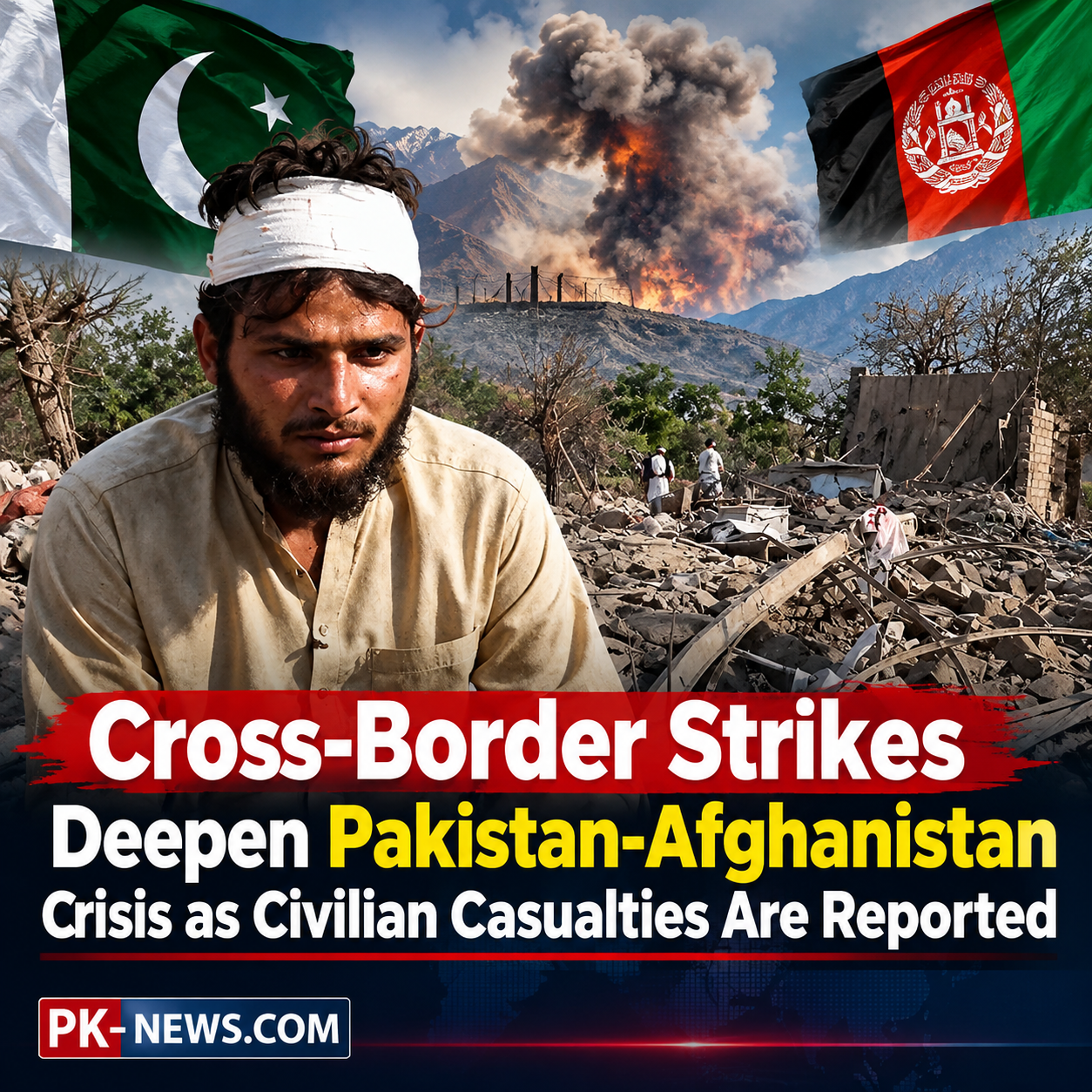
Fresh Pakistani airstrikes inside eastern Afghanistan have sharply increased tensions between Islamabad and Kabul, ending nearly three months of relative calm between the two neighbors.
Pakistan says its military targeted militant camps and hideouts linked to groups responsible for recent attacks inside Khyber Pakhtunkhwa. Afghan authorities, however, say the strikes hit civilian areas and killed civilians, including members of a family.
The conflicting accounts underline the growing difficulty of establishing what happened at the targeted locations and how the latest military escalation could affect relations between the two countries.
Family Killed in Kunar
In Kunar province, residents described the destruction of a family home following an overnight strike.
According to the account included in the footage provided to PK News, a resident named Ahmed said his parents and sister were killed when their house collapsed.
He described waking after explosions and finding his son alive while other family members were trapped beneath the rubble.
The destruction reportedly extended beyond the house, with nearby agricultural land and livestock also affected.
The incident has become a central part of Afghanistan's claim that the Pakistani operation caused civilian casualties.
Afghan officials said Pakistani aircraft struck areas in Kunar and Paktika early Monday. Afghan Taliban authorities reported three civilian deaths and four injuries. The United Nations also confirmed the reported civilian casualties.
Pakistan's Account Is Different
Islamabad has presented a substantially different explanation for the operation.
Pakistan's Ministry of Information and Broadcasting said the military conducted what it described as “calibrated” airstrikes against terrorist camps and hideouts in the border region with Afghanistan.
According to the Pakistani government, three targets were destroyed, including a facility used to train suicide bombers.
Pakistan said 28 militants, including several suicide bombers, were killed during the strikes. Officials also said weapons and ammunition stored at the targeted locations were destroyed.
The government said the strikes were based on intelligence and that precautions were taken to minimize civilian casualties.
Pakistan has repeatedly accused militant groups operating from Afghan territory of planning attacks inside Pakistan. Islamabad has particularly focused on the Pakistani Taliban, or TTP, and associated groups.
Strikes Follow Deadly Violence in Khyber Pakhtunkhwa
The latest escalation came shortly after a deadly attack in Kohat, Khyber Pakhtunkhwa.
On September 18, an attack near the old Police Lines area during Friday prayers killed at least 21 people and injured more than 100, according to police and reporting from the area. Eight attackers were later killed during a security operation.
The attack increased pressure on Pakistan's government to respond to militant threats.
Islamabad has accused groups based across the Afghan border of involvement in attacks against Pakistani security forces and civilians.
Afghanistan has rejected accusations that it knowingly allows militant groups to use its territory for attacks against Pakistan.
Kabul Condemns the Pakistani Operation
Afghan Taliban officials described the Pakistani strikes as an attack on Afghan territory.
Afghan authorities said civilians were among those killed and accused Pakistan of striking residential areas.
Taliban spokesman Zabihullah Mujahid said Afghanistan would respond, using what he described as an appropriate response.
The Afghan government has consistently rejected Islamabad's accusations that militant organizations are operating freely from Afghan soil.
This disagreement has become one of the most serious obstacles to improving relations between the two countries.
A Cycle of Retaliation
The latest developments fit a pattern that has repeatedly emerged along the Pakistan-Afghanistan border.
A militant attack occurs inside Pakistan.
Islamabad accuses groups operating from Afghanistan.
Pakistan then threatens or carries out action against suspected militant positions across the border.
Kabul condemns the operation and accuses Pakistan of violating Afghan sovereignty.
The resulting confrontation can then produce another round of military and diplomatic tensions.
The current escalation is particularly significant because the two countries had experienced a period of relative calm lasting almost three months.
The Human Cost
For communities living close to the border, the dispute is not simply a diplomatic confrontation.
Families living in Kunar, Paktika and other border provinces depend heavily on agriculture, livestock and small-scale work.
When homes, farmland or animals are destroyed, residents can lose both their shelter and their source of income.
The family described in the footage provided to PK News said they had previously returned from Pakistan and were trying to rebuild their lives in Afghanistan.
The destruction of their home demonstrates how quickly cross-border military confrontations can affect people who are not directly involved in the political dispute.
Competing Claims About the Targets
One of the most important unresolved questions is what was actually present at the locations struck.
Pakistan says its intelligence identified terrorist facilities, including a suicide-bomber training center.
Afghan authorities say civilian locations were struck.
Neither side's account independently establishes the complete picture of what happened at each site.
Reuters reported that Pakistan announced the deaths of 28 people it identified as militants but did not provide detailed information about the identities of those killed or the precise locations of the targets.
The UN's confirmation of civilian deaths adds another layer to the dispute but does not, by itself, determine whether the Pakistani military intentionally targeted civilians.
Regional Security Concerns
The confrontation is also attracting wider regional attention.
Pakistan and Afghanistan share a long and difficult border, with militant activity, refugee movements, trade and border-security disputes frequently affecting bilateral relations.
The deterioration in relations also creates concerns for neighboring countries that have encouraged dialogue between Islamabad and Kabul.
China, Qatar, Turkey and other regional actors have previously been involved in efforts to encourage communication between the two sides.
A prolonged confrontation could complicate those diplomatic efforts and increase instability along the border.
What Happens Next?
The immediate concern is whether the latest strikes will lead to further retaliation.
Pakistan has indicated that its counterterrorism campaign will continue and has argued that protecting its citizens remains its primary responsibility.
Afghanistan has warned that it will respond to further violations of its territory.
That leaves both countries facing a difficult choice between further military escalation and renewed diplomatic engagement.
The civilian casualties reported after the latest strikes could make negotiations even more difficult, particularly if additional incidents occur.
PK News Analysis
The latest Pakistan-Afghanistan confrontation is being described very differently by the two governments.
Pakistan's position: the strikes targeted militant infrastructure responsible for attacks in Pakistan, and Islamabad says 28 militants were killed.
Afghanistan's position: Pakistani aircraft struck Afghan territory and civilian areas, with three civilians killed and four wounded according to Afghan authorities and the UN.
The available evidence confirms that the two sides have fundamentally different accounts of the targets and casualties. Further independent investigation will be important in determining the circumstances surrounding individual strikes.
What is already clear is that the latest military action has ended a period of relative calm and created a new risk of retaliation along the Pakistan-Afghanistan border.
This article has been independently rewritten and prepared for publication by PK-News.com using the supplied video transcript and current reporting from multiple sources. It does not reproduce the original broadcast.
PK News — PK-News.com | Pakistan • Afghanistan • World News • Security • International Affairs
72
NEW
BREAKING
War
😔 Negative
Cross-Border Strikes Deepen Pakistan-Afghanistan Crisis as Civilian Casualties Are Reported
Related Articles You May Like
Related News







Comments (0)
Leave a Comment
No comments yet. Be the first to comment!