Missile Strikes Disrupt Riyadh Flights as the Makkah Defence Pact Faces Its First Major Test
RIYADH, SAUDI ARABIA — October 9, 2026: Saudi Arabia is facing mounting security challenges following a new wave of missile attacks claimed by Yemen’s Houthi movement, as regional allies debate how far they should go in supporting the kingdom under a mutual defence agreement.
The attacks on Thursday disrupted air travel, damaged civilian infrastructure and heightened concerns about the security of Saudi Arabia’s capital and energy facilities. Meanwhile, differences have emerged among Pakistan, Türkiye and other regional partners over whether their assistance should remain defensive or extend to direct military involvement in Yemen.
The developments have placed the Makkah Joint Defence Agreement, signed by Saudi Arabia, Pakistan and Türkiye in August, under renewed scrutiny as the conflict threatens to spread further across the region. Source: Dawn
Houthi Attacks Disrupt Riyadh
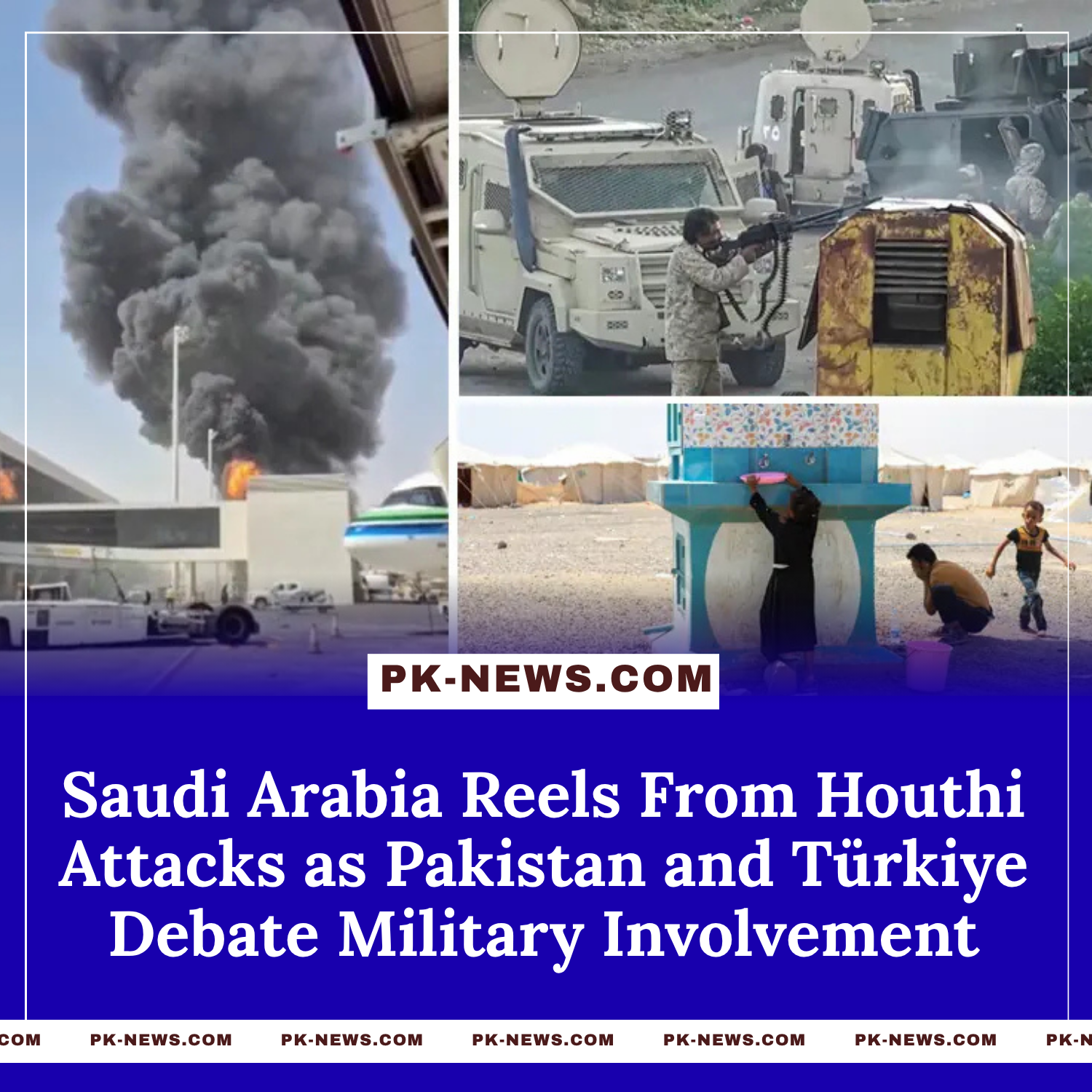
Yemen’s Houthi movement claimed responsibility for missile attacks targeting King Khalid International Airport in Riyadh and other Saudi military facilities.
Saudi authorities reported intercepting missiles aimed at the capital and Khamis Mushait. Debris from intercepted projectiles reportedly caused material damage to a kindergarten and a medical clinic complex in Riyadh, although the initial civil defence announcement did not specify whether anyone had been injured.
Videos verified by international news organisations showed smoke and flames rising from the airport area after a commercial aircraft caught fire while stationary. The incident added to concerns about the safety of civilian aviation as the attacks continued.
The Houthis also renewed threats against Saudi oil facilities, raising concerns about the potential impact on energy production and exports.
International Airlines Suspend Flights
The security situation has disrupted commercial aviation, with airlines reassessing the risks of operating flights to the Saudi capital.
Lufthansa and Air India announced suspensions of their Riyadh services amid the escalating attacks. Aviation data cited by Dawn indicated that approximately 49.7 per cent of departures from Riyadh airport had been cancelled by 1500 GMT on Thursday.
Travellers have been advised to check directly with airlines for the latest information about flight schedules and airport operations.
The disruptions illustrate how regional military escalation can affect international travel, business operations and the movement of passengers well beyond the immediate conflict zone.
Saudi Arabia Seeks Support From Its Allies
Saudi Arabia is seeking greater assistance from partner countries as it responds to Houthi advances and attacks on its territory.
The kingdom's immediate concerns include protecting cities, military installations, energy infrastructure and strategic maritime routes around the Red Sea.
An emergency meeting of countries associated with the Makkah defence agreement has focused attention on how the pact could be implemented in practice.
The agreement is intended to strengthen collective deterrence by treating an armed attack against one signatory as a threat to all three members. However, the latest crisis has exposed differences over what that commitment means operationally.
Pakistan Says Direct Involvement Is Not Ruled Out
Pakistan's Defence Minister Khawaja Asif said the agreement did not contain a provision preventing member states from becoming directly involved if one of them faced a threat.
Speaking to ARY News, Asif said the other members would be expected to help defend an attacked partner as though they were defending themselves.
His comments have fuelled discussion about the possible extent of Pakistan's role should the conflict escalate further.
However, his remarks do not, by themselves, establish that Pakistan has decided to launch combat operations against the Houthis in Yemen.
Pakistan's Ministry of Information has separately rejected reports alleging that Pakistani Air Force aircraft were being used in operations against the Houthis, describing one such report as false and fabricated. The ministry has also cautioned international media against speculative reporting about military deployments under the agreement.
The distinction between a mutual defence commitment and a confirmed operational deployment remains important as the situation develops.
Türkiye Emphasises a Defensive Role
Türkiye has adopted a more explicit public position against participating in offensive operations inside Yemen.
Turkish Foreign Minister Hakan Fidan said the Makkah agreement was defensive in nature and ruled out sending Turkish troops into another country's territory to conduct attacks.
Ankara has nevertheless indicated that it is considering ways to assist Saudi Arabia, particularly through air defence, technical capabilities and other defensive support.
Türkiye's position highlights the challenge facing the alliance: its members may agree on the need to protect Saudi territory while differing over whether that obligation extends to offensive military action against Houthi forces.
Syria Also Considers Its Options
Syria has reportedly been examining possible forms of assistance to Saudi Arabia, according to officials cited in international reporting.
Options under consideration include defensive support and military cooperation, although the precise nature of any potential contribution remains uncertain.
Syrian officials have stressed that any cooperation would take place through official channels and under existing bilateral arrangements.
Whether Syria will participate in a broader response remains unclear.
The Makkah Defence Agreement Faces a Critical Test
The agreement between Saudi Arabia, Pakistan and Türkiye was signed to strengthen security cooperation and collective deterrence.
Its first major test has raised practical questions about command arrangements, military coordination, the deployment of capabilities and the circumstances under which member states could participate in combat.
A commitment to collective defence does not automatically settle every operational question. Governments must still determine what assistance is required, what actions are authorised and how those actions fit within their national laws and security policies.
For Saudi Arabia, the challenge is to secure meaningful assistance without triggering a wider regional confrontation.
For Pakistan and Türkiye, the challenge is to fulfil their commitments while managing the risks associated with becoming directly involved in the Yemen conflict.
Yemen's Conflict and the Red Sea
The latest attacks are unfolding alongside intensified fighting in Yemen, where Houthi forces and Saudi-backed opponents remain locked in a struggle for territory and strategic influence.
The Red Sea and the Bab al-Mandeb Strait are especially important because they form part of a major international shipping corridor linking the Indian Ocean with the Mediterranean through the Suez Canal.
Any sustained disruption could affect commercial shipping, insurance costs, energy transportation and international supply chains.
Saudi Arabia and its partners therefore face a challenge that extends beyond the defence of individual cities or installations. They must also consider the security of maritime routes and the economic consequences of prolonged instability.
Oil Prices Rise Amid Regional Uncertainty
Financial markets have responded to the growing uncertainty with renewed attention to oil supplies and shipping risks.
Dawn reported that Brent crude futures rose by more than five per cent during Thursday's trading before paring some gains. By 1641 GMT, Brent was trading at $103.73 a barrel, while US West Texas Intermediate crude stood at $91 a barrel.
Oil prices can rise when traders anticipate supply disruptions, damage to energy infrastructure or increased risks to tanker movements.
However, price movements also reflect broader market conditions, including production expectations, inventories and diplomatic developments.
A prolonged escalation could add further pressure to energy markets and increase costs for countries that depend heavily on imported oil.
Washington's Position Adds Another Dimension
The attacks are taking place amid wider regional tensions involving Iran, the United States and Iran-aligned groups.
US President Donald Trump said Washington would not launch an attack on Iran before the November congressional midterm elections, according to the reporting cited by Dawn.
The statement came as regional governments weighed their responses to the attacks on Saudi Arabia.
The wider confrontation creates a difficult diplomatic environment. Actions intended to strengthen deterrence could also increase the risk of further retaliation if the conflict expands.
Regional governments must therefore weigh immediate security requirements against the potential costs of a broader war.
Civilian Safety Remains a Concern
The reported damage to a kindergarten and a medical facility in Riyadh highlights the risks facing civilians as missile attacks continue.
Airports, schools, healthcare facilities and energy infrastructure are essential to civilian life, making their protection a major concern during periods of armed conflict.
Authorities must assess damage, investigate possible casualties and maintain effective emergency procedures while ensuring that public information remains accurate.
The disruption to flights and instructions for some employees to work remotely also demonstrate how security incidents can affect ordinary life even when people are not directly injured.
What Happens Next?
The next phase will depend on the scale of further Houthi attacks, Saudi Arabia's military response and the practical decisions taken by its allies.
Key questions include whether Pakistan and Türkiye will provide additional defensive capabilities, whether the Makkah agreement will lead to any confirmed deployments and whether the conflict will expand into a wider regional confrontation.
At present, public statements from the agreement's members show a shared interest in Saudi security but differing interpretations of the limits of military involvement.
Any confirmed deployment or change in operational policy will be important in assessing the agreement's practical effect.
Conclusion: Allies Face Difficult Decisions
Saudi Arabia's latest security challenges have placed its regional partnerships under significant pressure.
The Houthi attacks have disrupted aviation, raised concerns about civilian infrastructure and contributed to uncertainty in energy markets. At the same time, the response has exposed differences among allied governments over how to translate collective-defence commitments into military action.
Pakistan has indicated that direct involvement is not expressly ruled out by the agreement, while Türkiye has publicly emphasised a defensive role and rejected sending troops to conduct offensive operations in Yemen.
The coming days will show whether the partners can coordinate an effective response while avoiding a wider escalation.
For now, the Makkah defence agreement faces a defining practical test as Saudi Arabia seeks to protect its territory amid continuing regional conflict.
PK-News.com International News Desk
This article has been developed and researched by the PK-News.com Digital News & Research Desk, based on reporting published by Dawn and other international news organisations.
Developed, Researched & Published by PK-News.com
Muhammad Ibraheem — Founder & Lead Architect
Website: PK-News.com
Pakistan & World News • Breaking News • Live TV • Blogs • Products • Digital Technology
14
War
😔 Negative
Saudi Arabia Reels From Houthi Attacks as Pakistan and Türkiye Debate Military Involvement
Related Articles You May Like
Related News





Comments (0)
Leave a Comment
No comments yet. Be the first to comment!