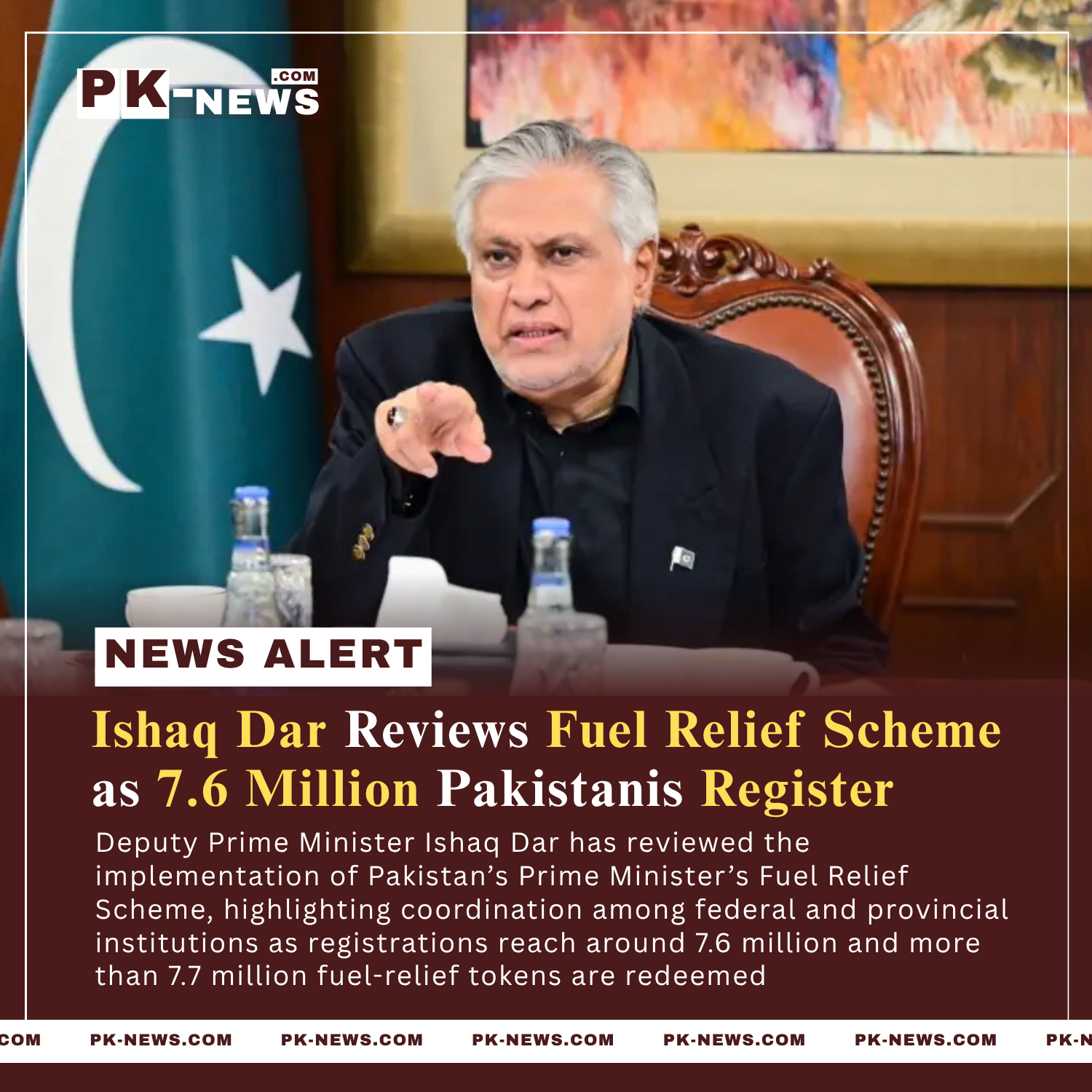
Deputy Prime Minister Ishaq Dar has reviewed the implementation of Pakistan’s Prime Minister’s Fuel Relief Scheme, highlighting coordination among federal and provincial institutions as registrations reach around 7.6 million and more than 7.7 million fuel-relief tokens are redeemed.
By PK-News.com | September 29, 2026
ISLAMABAD — Deputy Prime Minister and Foreign Minister Ishaq Dar on Tuesday chaired a meeting of the National Steering Committee on Fuel Subsidy to review the implementation of the government’s Prime Minister’s Special Fuel Relief Scheme.
During the meeting, Dar described the programme as an example of a coordinated “whole of government” approach, with several federal ministries, regulatory institutions, the State Bank of Pakistan and provincial authorities involved in its implementation.
The government launched the relief programme to provide targeted assistance to owners of motorcycles, rickshaws and vehicles with engines of up to 800cc amid elevated fuel prices and disruptions affecting international oil markets.
7.6 Million Registrations Completed
According to the latest government figures discussed at the meeting, approximately 7.60 million registrations have been successfully completed under the fuel relief programme.
The token redemption process has also entered its second week, with around 7.71 million tokens redeemed so far.
The figures indicate substantial participation in the programme since its nationwide rollout on September 17.
Dar directed the relevant authorities to maintain coordination and ensure that eligible beneficiaries can access the relief scheme without unnecessary difficulties.
How the Fuel Subsidy Works
Under the current structure, owners of two- and three-wheeled vehicles are eligible for a subsidy of Rs100 per litre against a monthly quota of 20 litres.
Owners of vehicles with engines of up to 800cc are eligible for the same Rs100-per-litre subsidy against a monthly quota of 30 litres.
The programme was introduced as a targeted relief measure rather than a general reduction in fuel prices.
The government has also made changes to the scheme during its implementation to improve access for beneficiaries, including adjustments involving registration and token redemption.
Multiple Institutions Involved
Dar highlighted the involvement of several government bodies in implementing the programme.
The Information Technology and Petroleum ministries, Oil and Gas Regulatory Authority (Ogra), State Bank of Pakistan and provincial administrations have all been involved in the implementation process.
The meeting was attended by IT Minister Shaza Fatima Khawaja, Information Minister Attaullah Tarar, senior federal and provincial officials and representatives of institutions including SBP, Ogra, the National Information Technology Board and Pakistan Digital Authority.
The government says continued coordination is necessary to ensure smooth service delivery throughout the country.
Fuel Prices Remain a Major Concern
The subsidy programme comes as Pakistan continues to face pressure from elevated international fuel prices.
The latest government price revision, announced on September 28, reduced petrol by Rs2.27 per litre and high-speed diesel by Rs3.56 per litre.
Following the adjustment, petrol was set at Rs389.03 per litre, while high-speed diesel was priced at Rs404.97 per litre.
Despite the reduction, fuel prices remain a major issue for households, transport operators and businesses.
Middle East Conflict Adds Pressure
The international energy situation has also complicated Pakistan’s fuel outlook.
Disruptions to major oil supply routes amid the continuing Middle East conflict have contributed to volatility in international energy markets.
The Strait of Hormuz remains particularly important because of its role in global oil transportation. Concerns have also emerged around the Bab al-Mandab shipping route.
These developments have increased uncertainty for countries that depend heavily on imported petroleum.
Pakistan’s government has therefore combined targeted fuel relief with conservation and austerity measures.
Government Introduces Conservation Measures
The government has also continued efforts to reduce fuel consumption by public institutions and businesses.
Earlier this month, authorities reintroduced austerity measures that included requiring markets to close at 9pm and reducing fuel allocations for official vehicles by 50 percent for three months.
Dar separately chaired a meeting of the committee responsible for monitoring implementation of these conservation and austerity measures.
Officials reviewed progress and discussed fiscal discipline and more efficient use of public resources.
Daily Fuel Price System
Pakistan also changed its fuel-pricing mechanism earlier this year.
In July, the government announced that petroleum prices would be adjusted on a daily basis in response to fluctuations in international markets.
Previously, fuel prices had generally been revised weekly.
The shift to more frequent adjustments was introduced against the backdrop of increased volatility in global oil markets.
For consumers, the new mechanism means domestic fuel prices can respond more quickly to movements in international petroleum prices.
IMF Talks and Pakistan’s Economic Position
The fuel situation is also unfolding as Pakistan conducts its latest discussions with the International Monetary Fund.
An IMF staff mission is currently in Islamabad for reviews under Pakistan’s $7 billion Extended Fund Facility and the $1.4 billion Resilience and Sustainability Facility.
The outcome of those discussions could have implications for Pakistan’s economic policy and fiscal management in the coming months.
The government is simultaneously seeking to maintain fiscal discipline while providing targeted assistance to consumers facing higher living costs.
What Happens Next?
The immediate focus will be on the continued redemption of fuel-relief tokens and ensuring that registered beneficiaries can access the subsidy.
Government agencies will also need to monitor whether the programme is reaching eligible households and whether implementation problems are emerging in different parts of the country.
At the same time, international oil prices and developments in the Middle East will remain important factors for Pakistan’s fuel market.
The government’s latest review indicates that the fuel relief programme remains an active component of its response to the current energy and economic pressures.
With millions of registrations already completed, authorities are now focused on maintaining the programme and ensuring smoother service delivery across Pakistan.
PK-News.com will continue monitoring fuel prices, government relief measures and developments affecting Pakistan’s energy and economy.
Developed by PK-News.com
1
NEW
Global
😔 Negative
Ishaq Dar Reviews Fuel Relief Scheme as 7.6 Million Pakistanis Register
Related Articles You May Like
Related News







Comments (0)
Leave a Comment
No comments yet. Be the first to comment!