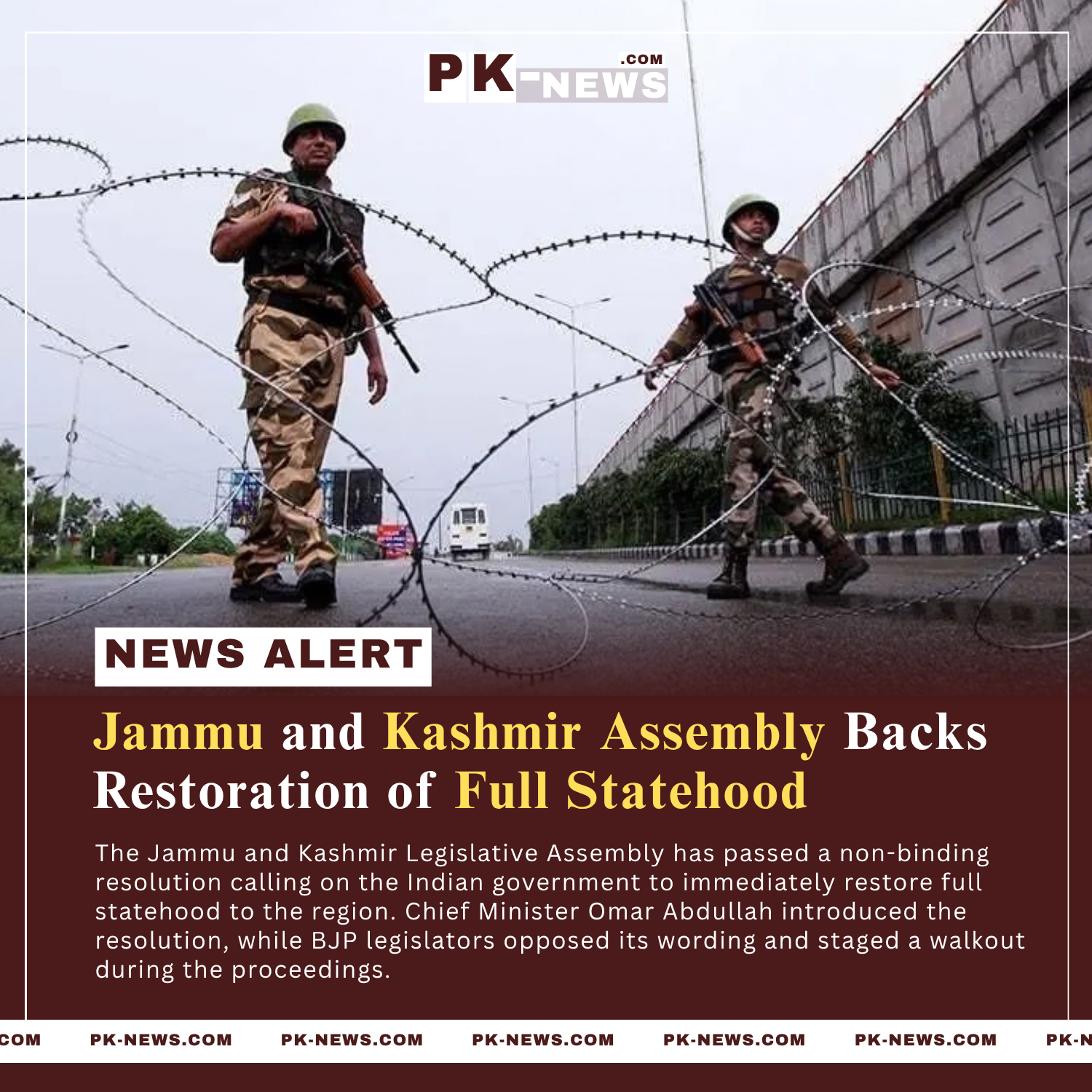
The Jammu and Kashmir Legislative Assembly has passed a non-binding resolution calling on the Indian government to immediately restore full statehood to the region. Chief Minister Omar Abdullah introduced the resolution, while BJP legislators opposed its wording and staged a walkout during the proceedings.
By PK-News.com News Desk
September 29, 2026
The Jammu and Kashmir Legislative Assembly has endorsed the restoration of full statehood to the region, passing a non-binding resolution calling on the government in New Delhi to take immediate steps towards restoring its former statehood.
PK-News.com has searched and reviewed the latest available reports and official developments surrounding the Assembly session. The resolution was introduced by Chief Minister Omar Abdullah and approved during a politically tense session in which legislators from India's ruling Bharatiya Janata Party (BJP) strongly objected to parts of the resolution.
The development is the latest chapter in the continuing political debate over Jammu and Kashmir's constitutional and administrative status following the changes introduced by New Delhi in 2019.
Assembly Calls for Immediate Restoration
The resolution calls upon the Government of India to ensure the “immediate and urgent restoration of full statehood” to Jammu and Kashmir.
It also directs that the resolution be forwarded to the central government in New Delhi.
However, the resolution is not legally binding. Its passage does not automatically restore statehood or change the region's current constitutional status. Any restoration would require action by India's central government.
Chief Minister Omar Abdullah argued that restoring statehood was a right of the region and said the Assembly was reminding the central government of commitments previously made regarding statehood.
BJP Legislators Walk Out
The resolution triggered strong objections from BJP legislators.
Members of the BJP staged a walkout before the vote, with some describing the resolution as unconstitutional and objecting to references contained in its text.
The BJP has indicated that it supports restoration of statehood in principle but opposes combining that demand with references to the region's previous constitutional arrangements, including issues connected with the period before 2019.
The disagreement resulted in heated scenes inside the Assembly, including protests and disruptions by opposition legislators.
Debate Over Earlier Constitutional Status
A major point of disagreement concerns references in the resolution to previous Assembly resolutions dealing with autonomy and Jammu and Kashmir's earlier constitutional arrangements.
The latest resolution refers to resolutions passed in 2000 and 2024.
The BJP has objected to connecting those earlier resolutions with the current demand for statehood.
BJP Leader of Opposition Sunil Sharma said his party supports statehood but does not support references to the pre-1953 position or the restoration of provisions that existed before the constitutional changes of 2019.
The distinction has become central to the political debate inside the Assembly.
What Changed in 2019?
The current dispute is rooted in major constitutional changes introduced by the Indian government in August 2019.
New Delhi removed Jammu and Kashmir's previous special constitutional status and reorganised the former state into two Union Territories.
The region subsequently came under greater direct administration from New Delhi.
The 2019 changes remain highly controversial and continue to influence political debate in Jammu and Kashmir as well as relations between India and Pakistan.
Election and Local Government
Jammu and Kashmir held Assembly elections in 2024, resulting in the formation of a government led by Omar Abdullah's National Conference.
The elected administration, however, operates with powers different from those previously exercised by the former state government.
The region continues to have a centrally appointed administrator, while important areas of governance remain subject to the constitutional framework established after 2019.
The statehood resolution is therefore being presented by its supporters as a demand for restoration of a fuller form of state government.
Omar Abdullah's Position
Omar Abdullah has repeatedly called for the restoration of statehood.
During the Assembly debate, he questioned why the central government had not yet acted despite previous assurances that statehood would eventually be restored.
He argued that the elected Assembly should formally communicate its position to New Delhi rather than wait indefinitely.
The resolution consequently represents a formal request from the elected regional legislature rather than an automatic constitutional change.
BJP's Position
The BJP's position, as expressed by its legislators, is more specific.
BJP leaders have said they support restoration of statehood but oppose attempts to combine the statehood demand with discussions about the region's former special constitutional status.
Sunil Sharma said the party would support a resolution dealing solely with statehood but objected to references to earlier political and constitutional arrangements.
This means the principal disagreement is not simply over the word statehood, but also over the historical and constitutional framework referenced in the Assembly resolution.
What Does the Resolution Actually Do?
The Assembly's decision should be understood as a political resolution rather than an immediate legal restoration of statehood.
Its main effects are:
It formally records the Assembly's demand for restoration of full statehood.
It asks India's central government to act.
It puts the issue back at the centre of political debate.
It does not itself change Jammu and Kashmir's current constitutional status.
It is not legally binding on New Delhi.
The next step therefore rests with the central government.
Wider India-Pakistan Context
Jammu and Kashmir remains a disputed territory claimed by both India and Pakistan.
The two countries have controlled different parts of the region since independence in 1947 and have fought multiple conflicts over the dispute.
The political developments inside Indian-administered Jammu and Kashmir therefore continue to attract attention in Pakistan and across the wider region.
The latest Assembly resolution is focused on statehood rather than directly changing the broader territorial dispute between India and Pakistan.
What Happens Next?
The central question is how New Delhi will respond to the Assembly's demand.
The Indian government has previously indicated that statehood would be restored at an appropriate time, but no immediate restoration has been announced alongside the Assembly resolution.
The issue is therefore likely to remain part of political discussions in Jammu and Kashmir in the coming months.
Further debate could also focus on whether any future statehood proposal will address only administrative status or include broader questions concerning the region's former constitutional arrangements.
PK-News.com Monitoring the Development
PK-News.com has searched and reviewed the latest available reports on the Jammu and Kashmir Assembly's statehood resolution.
The latest confirmed development is that the Assembly has passed a non-binding resolution calling for the immediate restoration of full statehood to Jammu and Kashmir.
Chief Minister Omar Abdullah supported the demand, while BJP legislators opposed parts of the resolution and walked out of the proceedings.
The resolution does not itself restore statehood. The final decision would require action by India's central government.
PK-News.com will continue monitoring developments and update this story as further verified information becomes available.
3
NEW
Global
😐 Neutral
Jammu and Kashmir Assembly Backs Restoration of Full Statehood
Related Articles You May Like
Related News




Comments (0)
Leave a Comment
No comments yet. Be the first to comment!