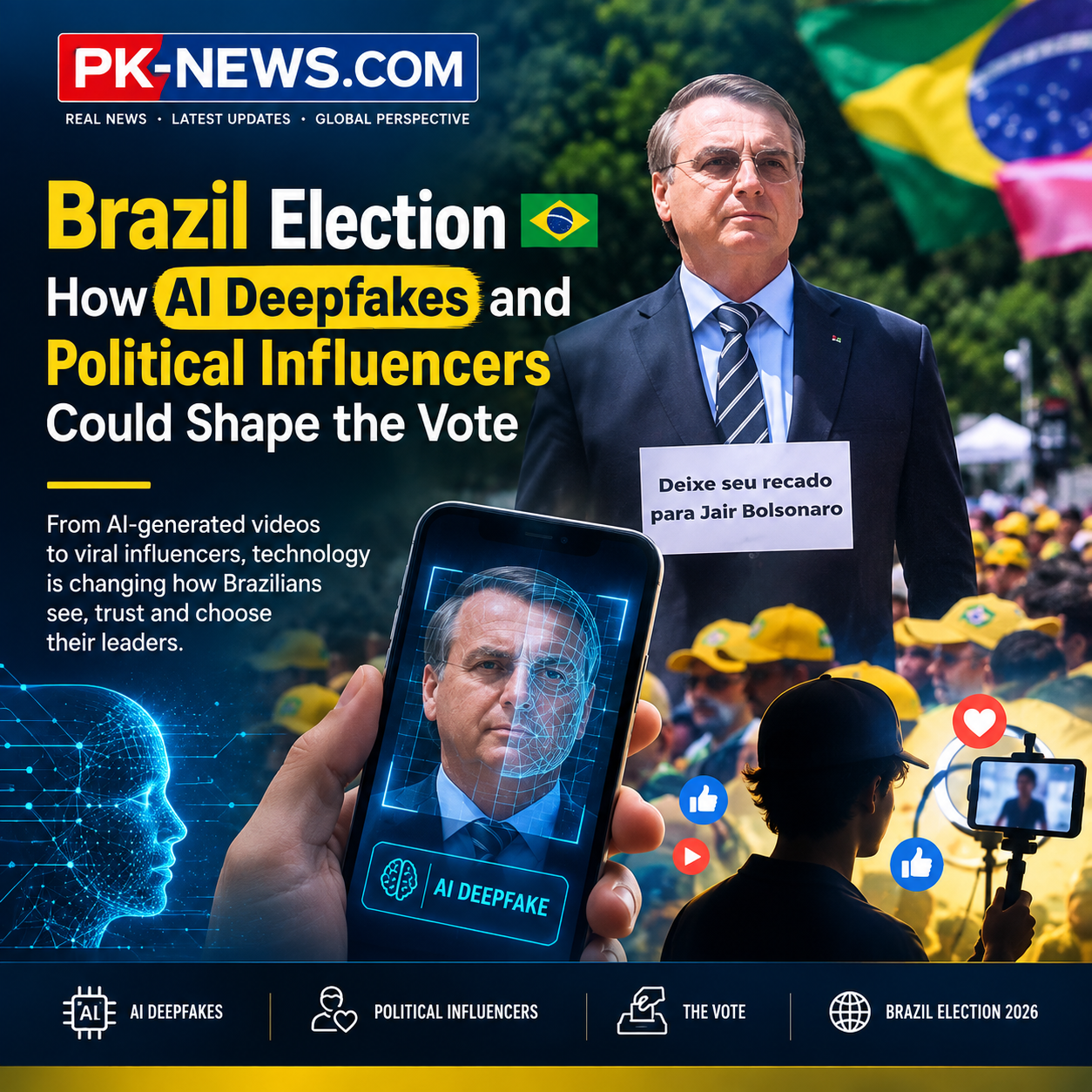
PK-News.com | International Brazil’s upcoming presidential election is attracting attention far beyond Latin America, with the country’s political direction expected to have implications for the global economy, environmental policy, international trade and efforts to combat organized crime. As one of Latin America’s largest economies and a major democratic power, Brazil also plays a crucial role in protecting the Amazon rainforest. The political choices made by Brazilian voters could therefore influence issues extending well beyond the country’s borders. The election has also highlighted a growing challenge facing democracies around the world: the rapid use of artificial intelligence to create political videos, digital personalities and realistic-looking deepfakes. A Closely Watched Political Contest The presidential race is being shaped by a sharp political divide over the future direction of Brazil. Left-wing President Luiz Inácio Lula da Silva is seeking another term and has emphasized social welfare, public education and healthcare investment. His political opponents, meanwhile, are campaigning on a tougher approach to crime and a more conservative vision for the country. The contest also carries significance for former President Jair Bolsonaro, whose political legacy remains a major issue in Brazil. His supporters and opponents continue to debate the events surrounding the unrest at government buildings in Brasília and the legal consequences that followed. One of the most controversial issues surrounding the election is whether a future administration could take action affecting Bolsonaro himself. AI Enters the Political Battlefield While presidential candidates dominate traditional campaigning, artificial intelligence has created a new and unusual group of political voices online. One example is an AI-generated character known as Dona Maria, portrayed as an elderly Brazilian woman who frequently comments on politics and criticizes government officials. The character became popular across social media, attracting millions of views and significant engagement. However, the woman appearing in the videos is not a real individual. The character was reportedly created by Daniel Christiano dos Santos, an Uber driver who said the appearance was inspired by his grandmother and that he also saw the project as a way to express his political opinions while generating additional income. Some of the character's videos attracted millions of views, demonstrating how quickly AI-generated personalities can become influential in online political discussions. Why Outrage Performs Well Online The popularity of such content reflects a broader problem with social media algorithms. Political material that creates anger, fear or strong emotional reactions can generate large numbers of comments, shares and other interactions. This can give controversial material greater visibility and allow AI-generated political content to spread rapidly. For political creators, the combination of artificial intelligence and social media creates a powerful production system. A single individual can produce convincing videos featuring fictional characters, politicians or other public figures without the resources traditionally required for television production. That raises concerns about whether voters can easily distinguish genuine political communication from manipulated material. Deepfakes Target Brazil's Political Figures AI-generated videos have also been used to recreate Brazilian political figures, including Lula and Jair Bolsonaro. Some videos appear designed to encourage people to support particular candidates, while others portray politicians making statements they did not actually make. The problem becomes particularly serious during the final stage of an election campaign. False material released shortly before voting day may spread rapidly before journalists, election authorities or fact-checkers have enough time to investigate it. Experts caution that it would be difficult to prove that deepfakes alone could determine the result of an election. However, misleading AI content could still disrupt campaigns, influence undecided voters and intensify political divisions. Electoral Authorities Face a New Challenge The growing use of AI-generated political content has already triggered political and legal concerns in Brazil. Political groups have sought action against accounts accused of spreading misleading or manipulated content. In one case involving the Dona Maria character, an account was removed after complaints concerning its political reach. But removing one account does not necessarily solve the wider problem. Creators can establish new accounts, reuse existing audiences and distribute content across multiple platforms. This makes enforcement considerably more difficult. The Business Behind AI Political Content The Brazilian experience also shows that AI political content is not necessarily being produced solely for political purposes. Some creators have discovered that viral political videos can generate an audience that can later be monetized through advertising, courses and other digital products. The creator associated with Dona Maria reportedly began offering training on how to produce AI-generated videos. This illustrates how the technology is developing into a commercial opportunity alongside its political impact. The result is a new digital ecosystem in which political influence, entertainment, social-media engagement and online income can overlap. What This Means Beyond Brazil Brazil's election provides an important example of a challenge that other democracies may increasingly face. Artificial intelligence has dramatically reduced the cost and technical expertise required to create convincing political material. A fabricated video can now be produced and distributed to thousands or millions of people through social platforms. For voters, this means that seeing a politician or ordinary-looking person speaking in a video is no longer enough to establish that the content is authentic. The Brazilian election therefore represents more than a domestic political contest. It is also a test of how democratic societies respond to AI-generated misinformation, deepfakes and increasingly sophisticated digital campaigning. As artificial intelligence becomes more accessible, governments, election authorities, technology companies, journalists and voters will all face greater pressure to identify manipulated content and protect the integrity of political debate. PK-News.com Analysis: The growing influence of AI-generated political content demonstrates why digital literacy and reliable verification are becoming increasingly important during elections. Technology can give ordinary creators a powerful voice, but the same tools can also make misinformation much easier to produce and distribute.
3
NEW
International
😔 Negative
Brazil Election How AI Deepfakes and Political Influencers Could Shape the Vote
Related Articles You May Like
Related News







Comments (0)
Leave a Comment
No comments yet. Be the first to comment!