0
NEW
Global
😐 Neutral
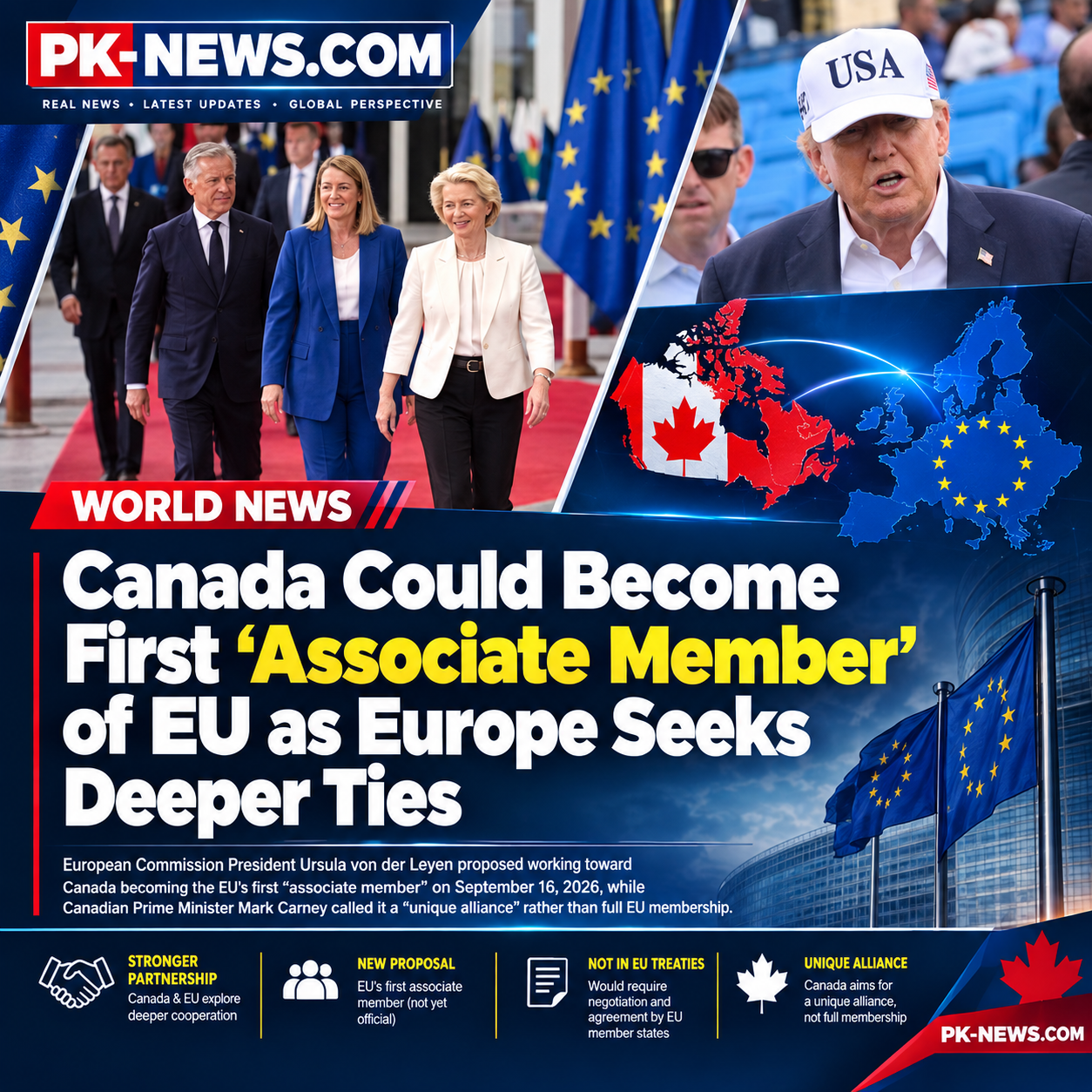
Canada Could Become First Associate Member of EU as Europe Seeks Deeper Ties
By Muhammad Ibraheem | PK News
September 17, 2026
Canada could become the first country to receive a new “associate member” status within the European Union after European Commission President Ursula von der Leyen proposed opening the door to a much closer relationship between Brussels and Ottawa.
The proposal was announced during von der Leyen’s annual State of the Union address to the European Parliament in Strasbourg on September 16, with Canadian Prime Minister Mark Carney attending the speech.
Von der Leyen told Carney that the European Union wanted to take its relationship with Canada to the “highest level possible” and work toward making Canada the bloc’s first associate member.
The announcement represents a significant potential change in the relationship between Canada and Europe, but it does not mean Canada is becoming a full EU member.
Instead, Brussels is discussing a new form of partnership that could give Canada closer access to European cooperation while leaving the country outside the EU's existing full-membership structure.
What Does ‘Associate Member’ Mean?
One of the biggest questions surrounding the proposal is that associate membership is not currently an established EU membership category.
The European Union currently has 27 full member states. Countries seeking full membership must go through a formal accession process and meet extensive political, legal and economic requirements.
Canada is not an EU candidate country.
The proposed associate status would therefore represent something different from traditional EU enlargement.
According to current reporting, the exact rights and responsibilities of an associate member have not yet been defined. The European Commission would need to work with EU member states and the European Parliament to establish the details of the proposed arrangement.
That means questions about market access, regulatory alignment, participation in EU programs, political consultation and other areas would still have to be negotiated.
Why Is Canada Being Considered?
Canada and the European Union already have an extensive economic relationship.
The two sides have worked together through the Comprehensive Economic and Trade Agreement, commonly known as CETA.
The proposed new relationship could go considerably further, particularly in strategic sectors such as:
Technology
Artificial intelligence
Critical minerals
Energy
Defence
Manufacturing
Digital trade
Infrastructure
Supply-chain security
Von der Leyen's proposal comes as Europe seeks to strengthen relationships with partners outside the traditional EU framework.
The European Commission has described the changing international environment as a reason for developing stronger partnerships with countries that share democratic values and strategic interests.
Mark Carney Wants a Closer European Relationship
Canadian Prime Minister Mark Carney has also been pushing for stronger ties with Europe.
Carney has described Canada's objective as building a “unique alliance” with the European Union rather than seeking conventional full EU membership. Reuters reported that Canada has been exploring closer cooperation with Europe in areas including energy, artificial intelligence, critical minerals and infrastructure.
The Canadian government has also been looking for ways to diversify its international economic relationships.
Canada's economy has traditionally been deeply connected to the United States, making the relationship with Washington extremely important for Canadian trade.
Recent trade tensions between Canada and the United States have increased interest in strengthening economic partnerships elsewhere.
Trade Tensions With the United States
The EU proposal comes against a backdrop of increased trade tensions between Canada and the United States.
The possibility of a closer Canada-EU relationship has attracted attention in Washington.
President Donald Trump criticized the idea on September 16, suggesting that an EU decision to bring Canada into an associate relationship could be considered a hostile move if it were motivated by negative intentions toward the United States.
Trump also threatened possible economic retaliation against Europe if he concluded that the arrangement was being used against the United States.
The comments demonstrate how a proposed Canada-EU arrangement could have implications beyond Canada and Europe.
Could Canada Get Access to the EU Market?
This remains one of the biggest unanswered questions.
An associate relationship could potentially involve deeper economic cooperation, but there is currently no finalized framework establishing what Canada would receive.
Canada and the EU already have CETA, meaning the proposed relationship would need to offer something beyond the existing trade agreement if it is to become a meaningful new partnership.
European officials would have to determine whether an associate member would receive additional market access, participate in EU programs or cooperate more closely on regulations.
The details could take considerable time to negotiate.
Defence and Security Could Become Important
Defence is another area where Canada and Europe could expand cooperation.
The changing global security environment has encouraged European countries to reconsider their defence capabilities and relationships with international partners.
Canada is already a member of NATO, meaning it has an established security relationship with many European countries.
An enhanced EU-Canada relationship could therefore complement existing NATO cooperation rather than replace it.
Possible areas of cooperation could include defence industries, military procurement, cybersecurity, Arctic security and strategic infrastructure.
Critical Minerals and Energy
Critical minerals are also becoming increasingly important in relations between Canada and Europe.
Canada has significant natural resources that are important for modern industries, including technologies used in batteries, electronics and renewable-energy systems.
European governments and companies are seeking more secure supply chains for these materials.
Closer cooperation with Canada could therefore help Europe diversify its sources of critical minerals.
Energy could also become an important part of the relationship.
Canada has substantial energy resources, while European countries have been working to strengthen energy security and diversify supplies.
Artificial Intelligence and Technology
Technology could become another major area of cooperation.
Canada is one of the countries with a significant research and development community in artificial intelligence.
Europe is also developing its own approach to AI regulation and technology policy.
Closer cooperation could involve research partnerships, investment, digital infrastructure, AI governance and technology development.
The EU has already identified technology and artificial intelligence as strategic areas where international partnerships could become increasingly important.
Canada Would Not Become a Full EU Member
It is important to distinguish the proposal from ordinary EU membership.
Full EU membership would give a country representation within EU institutions and participation in the bloc's decision-making structures according to EU rules.
The proposed associate status is different.
The EU has not yet established what political representation, voting rights or institutional participation an associate member would receive.
One comparison discussed in reporting is the relationship some non-EU European countries have with the bloc through arrangements such as the European Economic Area, although Canada's potential arrangement could be designed differently.
Until negotiations produce a formal framework, it is not possible to say exactly what Canada would gain or what obligations it would accept.
Other Countries Could Watch the Proposal Closely
Canada's potential status could also affect the EU's wider approach to countries outside the bloc.
Several European countries are currently seeking full EU membership, while other countries maintain close economic and political relationships with the bloc without being full members.
Creating a new associate category could provide the EU with another model for building relationships with countries that are geographically or politically outside the traditional enlargement process.
At the same time, governments seeking full membership could question whether a new associate system creates a different route to close integration without the same requirements as full accession.
What Happens Next?
The proposal is only the beginning of the process.
The European Union's 27 member states would need to discuss the idea, and the European Parliament would also have a role in the development of any new institutional arrangement.
Canada and the EU would then need to negotiate the details of the relationship.
The two sides are expected to continue discussions ahead of the planned EU-Canada summit in Montreal on October 29–30, 2026, where closer cooperation could be discussed further.
Until those negotiations are completed, Canada remains outside the European Union and continues to have its existing relationship with the bloc.
A New Chapter in Canada-Europe Relations?
The proposal marks a potentially important moment in Canada-EU relations.
For Europe, closer cooperation with Canada could strengthen partnerships in trade, energy, technology, critical minerals and security.
For Canada, deeper European ties could provide another avenue for international economic and strategic cooperation at a time when relations with its largest trading partner, the United States, have become more complicated.
But major questions remain unanswered.
What would associate membership actually provide? Would Canada gain additional access to the European market? Would it have a role in EU decision-making? What regulations would Canada have to follow? And would all 27 EU member states agree to the arrangement?
Those questions will have to be addressed before the proposal becomes a formal agreement.
For now, the development is best understood as an invitation to negotiate a new relationship, not as Canadian membership of the European Union.
Key Facts
Country: Canada
Proposed status: EU “associate member”
EU membership: 27 full member states
Canadian Prime Minister: Mark Carney
European Commission President: Ursula von der Leyen
Proposal announced: September 16, 2026
Location: European Parliament, Strasbourg
Potential cooperation: Trade, technology, AI, energy, defence and critical minerals
Current status: Proposal under discussion
Full EU membership: Not proposed
Next major meeting: EU-Canada summit in Montreal, October 29–30, 2026
PK News will continue to follow developments as Canada and the European Union discuss the proposed new partnership.
Sources: European Union reporting, Reuters, Associated Press and other current international reporting.
Published by: PK News
Author: Muhammad Ibraheem
Related Articles You May Like
Related News










Comments (0)
Leave a Comment
No comments yet. Be the first to comment!