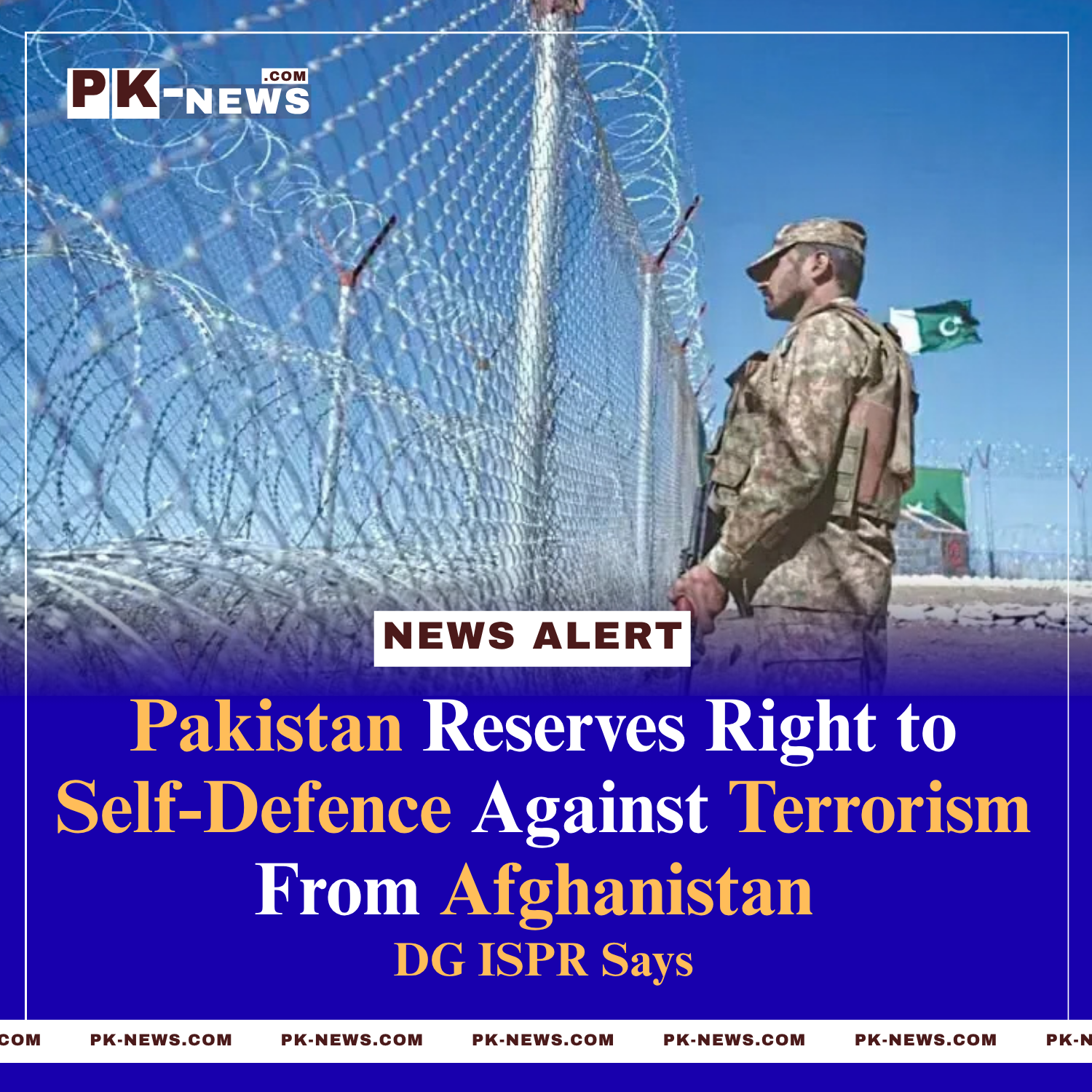
ISLAMABAD — Pakistan has reiterated that it reserves the right to defend itself against terrorism and security threats originating from Afghanistan, with Director General Inter-Services Public Relations (DG ISPR) Lieutenant General Ahmed Sharif Chaudhry saying that “everything that is necessary will be done” to protect the country's territorial integrity and security.
The remarks came during a press briefing on Thursday, October 1, 2026, as Pakistan continued to address concerns over militant activity linked to Afghan territory and the broader security situation along the Pakistan-Afghanistan border.
Pakistan Says Territorial Integrity Is Non-Negotiable
During the briefing, the DG ISPR said Pakistan's policy was clear regarding its sovereignty and territorial integrity. He stated that there would be no compromise over threats to Pakistan's security and stability.
He further said Pakistan has a right to self-defence and that the armed forces would take whatever measures they consider necessary in response to threats. The statement was made specifically in the context of questions about terrorism and attacks emanating from Afghanistan.
Focus on Terrorism From Afghan Territory
Pakistan has repeatedly raised concerns with the authorities in Kabul over militant groups allegedly operating from Afghan territory. Islamabad has particularly focused on the Tehreek-i-Taliban Pakistan (TTP), which Pakistan says uses Afghan territory to organize and launch attacks inside the country.
In a September 19 interview, the DG ISPR said Pakistan's principal demand was that Afghan territory should not be used for terrorism against Pakistan. He also said Islamabad reserved its right to self-defence if commitments concerning terrorism were not fulfilled.
Pakistan Cites Right to Self-Defence
The latest statement builds on Pakistan's previously stated position that the country has a right to defend its population against cross-border terrorism.
Earlier, the DG ISPR referred to Article 51 of the United Nations Charter, saying Pakistan reserves its right to self-defence while dealing with threats originating from Afghan territory. He said Pakistan would continue taking measures intended to protect the lives and property of its citizens.
The latest briefing did not itself announce a specific new military operation, but it reinforced the position that Islamabad considers countering cross-border terrorism a matter of national security.
Tensions Between Islamabad and Kabul
Relations between Pakistan and Afghanistan have remained strained over allegations involving militant groups and cross-border attacks.
Islamabad has repeatedly accused the Afghan authorities of allowing militant organizations to maintain safe havens on Afghan soil. Kabul has rejected such accusations and has disputed Pakistani claims concerning attacks and militant activity originating from Afghanistan.
The disagreement has become one of the central issues affecting relations between the two neighboring countries.
Border Security Remains a Major Concern
The Pakistan-Afghanistan border remains a major security concern for Islamabad because of its length, difficult terrain and the presence of militant networks in the wider region.
Pakistan's security forces have conducted counterterrorism operations for years, particularly in areas of Khyber Pakhtunkhwa and Balochistan. Pakistani officials maintain that militant groups operating from or through Afghanistan pose a direct threat to communities and security personnel inside Pakistan.
Earlier Military Escalations
The latest warning comes after previous periods of serious military tension between Pakistan and Afghanistan.
In February 2026, Pakistan's military announced strikes against what it described as militant and military targets in Afghanistan following clashes along the border. Afghan authorities disputed aspects of Pakistan's account and the reported casualties.
Because claims from both sides have sometimes differed significantly, casualty figures and battlefield assessments should be treated according to the source making the claim unless independently verified.
Recent Cross-Border Strikes
The security situation has continued to develop in recent days. Reuters reported on October 1 that Pakistani airstrikes targeted locations in Afghanistan's Kunar and Helmand provinces. Afghan authorities said civilians were killed, while Pakistan said its strikes targeted militant hideouts and reported militant casualties.
The competing accounts have not been independently reconciled, highlighting the continuing difficulty of establishing a common factual account during cross-border military operations.
Pakistan Says Its Target Is Terrorism
The Pakistani military has repeatedly framed its Afghanistan-related security policy around preventing terrorism from reaching Pakistani territory.
In his September interview, the DG ISPR said Pakistan's issue was with the use of Afghan territory by militant organizations rather than with the Afghan people. He said Islamabad wanted the authorities in Afghanistan to prevent terrorist groups from using their territory to plan or launch attacks against Pakistan.
This distinction has been part of Pakistan's public messaging as tensions with Kabul have increased.
Kabul's Position
Afghan authorities have rejected Pakistan's accusations that Afghanistan is deliberately being used to facilitate attacks against Pakistan. Kabul has maintained that security problems inside Pakistan are primarily an internal matter and has disputed Pakistani accounts of military operations and casualties.
Recent clashes and airstrikes have therefore been accompanied by competing statements from Islamabad and Kabul, with each side presenting different accounts of events along the border.
Regional Security Implications
Continued tensions between Pakistan and Afghanistan could have wider consequences for regional security, particularly because the two countries share a long and strategically important border.
The situation is also being watched by neighboring and regional countries concerned about terrorism, cross-border movement, trade and stability. Diplomatic efforts involving regional states have previously sought to reduce tensions and encourage communication between Islamabad and Kabul.
For Pakistan, preventing attacks linked to militant groups remains a central security priority, while Afghanistan continues to reject accusations that it intentionally provides support for terrorism against its neighbor.
What the DG ISPR Statement Means
The latest comments indicate that Pakistan's military leadership continues to regard terrorism originating from Afghan territory as a serious national-security threat.
The statement that “everything that is necessary will be done” signals that Islamabad continues to maintain its stated right to respond to threats, while the government and military have previously also emphasized the need to prevent terrorism and protect Pakistan's territorial integrity.
However, the statement by itself does not announce a particular future military action. Any subsequent operation, diplomatic initiative or border-security measure would depend on developments and decisions by Pakistan's authorities.
PK-News.com Update
The latest statement from DG ISPR Lt Gen Ahmed Sharif Chaudhry comes amid heightened Pakistan-Afghanistan tensions and continuing disagreements over cross-border terrorism. Pakistan says Afghan territory must not be used to launch attacks against Pakistan and has reiterated its claimed right to self-defence.
At the same time, Kabul has rejected Islamabad's accusations, while recent military incidents have produced conflicting accounts from the two sides. The situation remains fluid, with security developments and diplomatic engagement likely to shape the next phase of Pakistan-Afghanistan relations.
This article was developed and researched by PK-News.com based on statements and reports available on October 1, 2026.
2
NEW
Global
😔 Negative
Pakistan Reserves Right to Self-Defence Against Terrorism From Afghanistan, DG ISPR Says
Related Articles You May Like
Related News








Comments (0)
Leave a Comment
No comments yet. Be the first to comment!