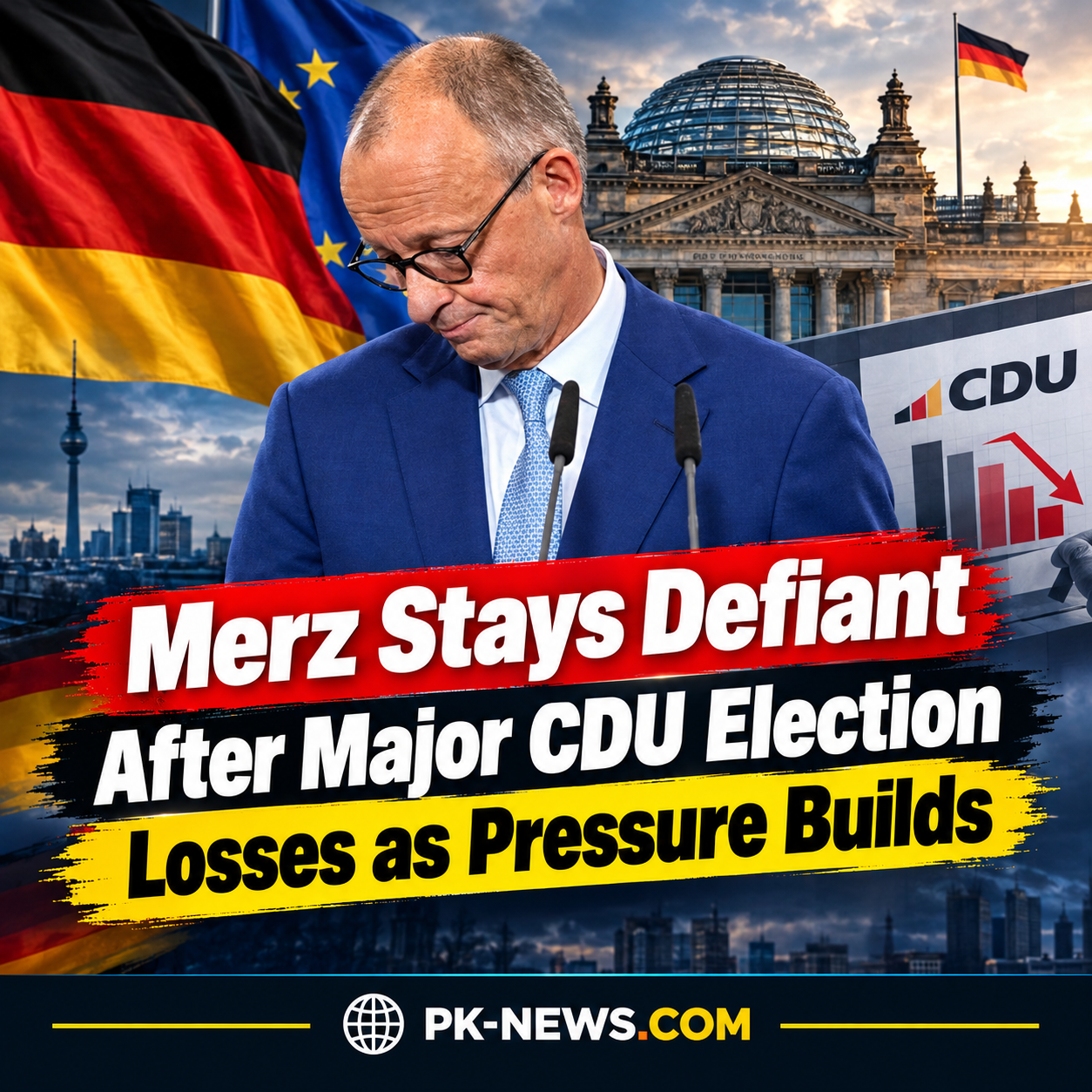
German Chancellor Friedrich Merz has rejected calls for him to step aside and pledged to continue leading the government after his Christian Democratic Union (CDU) suffered major setbacks in two state elections.
The results from Mecklenburg-Western Pomerania and Berlin have intensified debate inside Germany about the future of Merz's leadership, his government's economic policies and the CDU's ability to regain support ahead of the next federal election.
Merz himself described the Mecklenburg-Western Pomerania result as a “disaster” for his party. Despite the setback, he said he would remain both CDU chairman and chancellor and continue with his government's reform program.
Historic Setback in Mecklenburg-Western Pomerania
The most dramatic result came in the northeastern state of Mecklenburg-Western Pomerania.
Preliminary figures put the CDU at around 4.9%, placing it close to or below the five-percent threshold required for representation in the state parliament. If the final result remains below that threshold, it would represent the CDU's lowest state-election performance since the end of World War II.
The Alternative for Germany (AfD) made substantial gains and emerged as the strongest party in the preliminary results, with figures around 38%.
The result does not automatically mean the AfD will control the state government. Other major parties have ruled out cooperation with it, meaning coalition negotiations remain important in determining who will govern.
The result nevertheless represents another significant increase in the AfD's support in eastern Germany.
CDU Also Loses Ground in Berlin
Berlin delivered another difficult result for Merz's party.
Preliminary figures showed the CDU at around 19%, behind Die Linke, which was projected at approximately 25%. The AfD also recorded a double-digit result in the capital.
The Berlin result is particularly significant because the city is one of Germany's most politically important regions and is home to the federal government's institutions.
The two elections therefore produced setbacks for the CDU in very different political environments.
Merz Refuses to Abandon His Reform Agenda
Speaking after the initial results, Merz acknowledged the seriousness of the CDU's performance but rejected the idea that his government should abandon its policy program.
He said Germany needs reforms in areas including taxation, pensions, healthcare and reducing bureaucracy.
Merz argued that the country's economic difficulties make structural reforms more necessary rather than less important.
“I will demonstrate these qualities as chairman of the CDU and, above all, as chancellor of our country,” Merz said, according to reports of his election-night statement.
He also said that the federal government had been elected for a four-year term and that he intended to use that period to address Germany's economic and political challenges.
Growing Pressure Inside the CDU
The latest results come after weeks of growing criticism of Merz.
The CDU had already suffered a major setback in Saxony-Anhalt earlier in September, where the AfD achieved a strong result. That outcome increased discussion within the conservative party about Merz's leadership.
Following the latest elections, however, Merz's supporters have continued to back him.
Germany's political system also makes replacing a sitting chancellor more complicated than simply changing the party leader. A new chancellor would need sufficient parliamentary support, while the governing coalition would have to remain capable of securing a majority in the Bundestag.
For now, Merz has made clear that he intends to remain in office.
Economic Problems Remain a Central Issue
The election results also reflect wider concerns about Germany's economy.
Europe's largest economy has struggled with weak growth, industrial pressure and high energy costs. Germany's major manufacturing industries, including automotive production, have faced increasing competition and structural changes.
Merz came to office promising to strengthen economic growth and introduce reforms intended to improve Germany's competitiveness.
The latest electoral setbacks have increased scrutiny of whether voters believe those policies are producing sufficient results.
The chancellor has argued that some reforms will be difficult and potentially unpopular but necessary for Germany's long-term economic position.
The AfD's Continued Rise
The latest state elections also demonstrate the continued strength of the AfD in parts of Germany.
The party performed particularly strongly in Mecklenburg-Western Pomerania, while also making gains in Berlin.
The AfD has made immigration, economic concerns, energy costs and opposition to Germany's support for Ukraine important parts of its political message.
Other German parties have maintained a policy of refusing cooperation with the AfD at the government level, meaning strong electoral results do not automatically translate into participation in regional governments.
Nevertheless, the party's growing vote share has placed additional pressure on the established parties.
What Happens Next?
Merz now faces the challenge of rebuilding support for the CDU while continuing to govern through the federal coalition.
The immediate political debate is likely to focus on whether the latest election results require changes to the government's strategy or simply stronger communication and implementation of its existing program.
Merz has chosen the latter approach so far, saying that Germany needs to continue with reforms rather than retreat from them.
The CDU's performance in future elections will provide further evidence of how voters respond to that strategy.
For now, the German chancellor remains in office and has publicly rejected suggestions that the latest electoral defeats should end his leadership.
PK News Analysis
The September 2026 state elections have produced a significant political setback for Merz's CDU, particularly in Mecklenburg-Western Pomerania. However, the results do not themselves remove Merz as chancellor. He has explicitly committed to remaining in office and continuing his government's reform agenda.
The political consequences will depend on developments within the CDU, the governing coalition, future policy decisions and subsequent elections.
This article has been independently rewritten and prepared for PK-News.com from current reporting by established news organizations. It does not reproduce the original source article.
PK News — PK-News.com | World News • Politics • Business • International Affairs
2
NEW
Politics
😐 Neutral
Merz Stays Defiant After Major CDU Election Losses as Pressure Builds
Related Articles You May Like
Related News






Comments (0)
Leave a Comment
No comments yet. Be the first to comment!