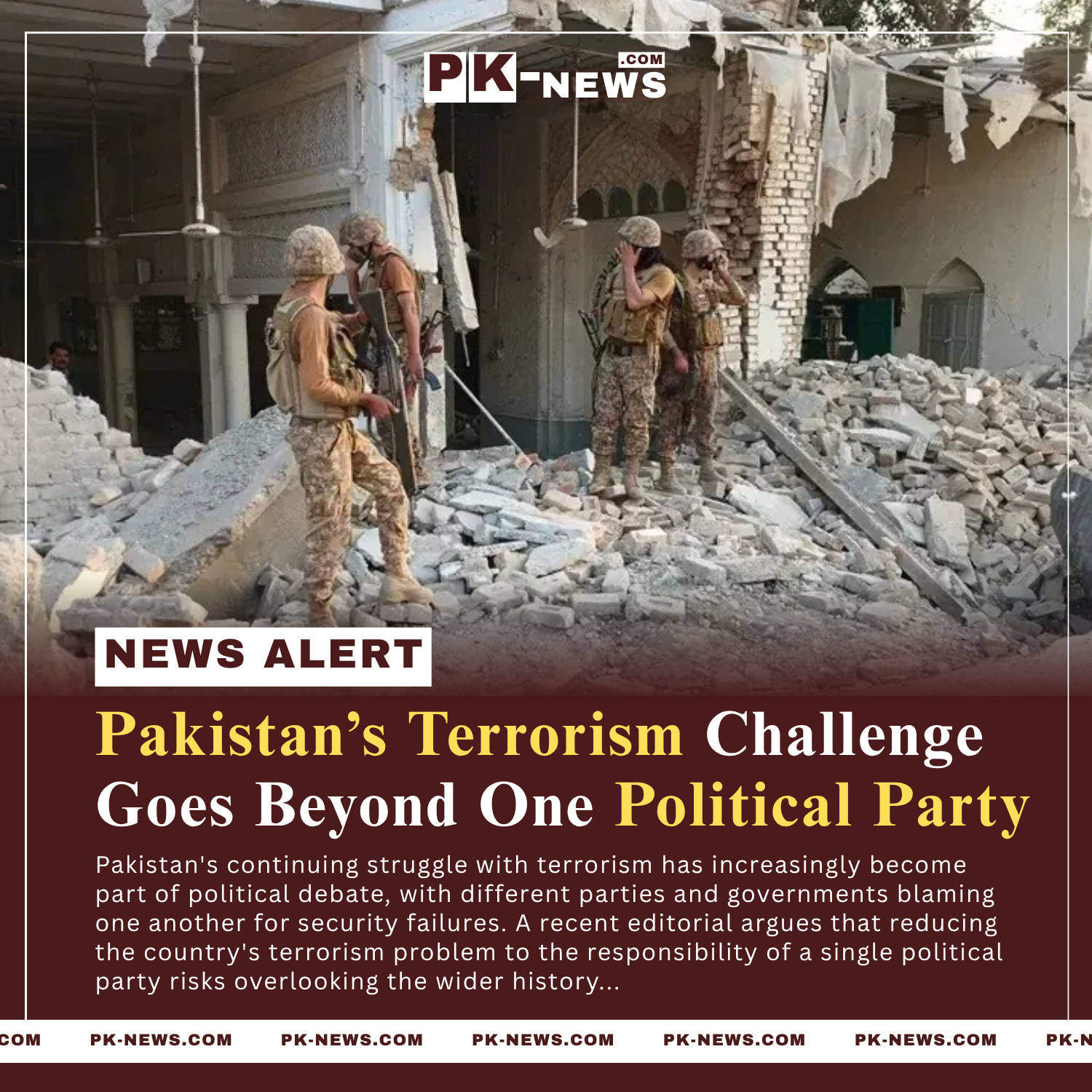
Pakistan's continuing struggle with terrorism has increasingly become part of political debate, with different parties and governments blaming one another for security failures. A recent editorial argues that reducing the country's terrorism problem to the responsibility of a single political party risks overlooking the wider history, institutional challenges and policy decisions that have shaped Pakistan's security environment.
By PK-News.com
September 29, 2026
Pakistan's terrorism challenge has once again become the subject of intense political debate, particularly following renewed attacks in Khyber Pakhtunkhwa and growing disagreement between the federal government and the provincial administration.
PK-News.com has reviewed the arguments presented in the latest editorial discussion and is presenting the issue as an analysis of the competing political positions, rather than attributing responsibility for terrorism to any single political party.
The debate has become particularly visible amid recent exchanges between federal ministers and the Khyber Pakhtunkhwa government over counterterrorism policy.
Terrorism Has a Long and Complicated History
Pakistan's struggle with militancy did not begin with one political party or one provincial government.
Over several decades, the country has experienced attacks involving different militant organisations, with security challenges changing considerably over time.
Military operations, intelligence-based actions, policing, border management, negotiations and political strategies have all been used by successive governments and state institutions.
As a result, the country's present security environment has been shaped by decisions made across different periods rather than by one administration alone.
Political Blame Has Become Part of the Debate
Recent statements from federal officials have criticised the Khyber Pakhtunkhwa government over its handling of terrorism.
Federal ministers have questioned provincial security policies, resources and political positions concerning Afghanistan.
The KP government, meanwhile, has argued that the province has suffered disproportionately from terrorism and that decisions concerning counterterrorism should involve the provincial administration.
Chief Minister Sohail Afridi has called for changes to the existing counterterrorism approach and greater participation by KP authorities in security policymaking.
These competing positions demonstrate the political disagreement surrounding the issue.
However, political accusations and responsibility for individual attacks are not necessarily the same thing.
Why a Broader Examination Matters
A serious examination of Pakistan's terrorism problem requires attention to several factors.
These include:
The activities of militant organisations
Cross-border security concerns
Developments in Afghanistan
Intelligence and law-enforcement capabilities
Police resources and training
Federal-provincial coordination
Border management
Previous counterterrorism policies
Economic and social conditions in affected areas
Looking at only one political party can leave important parts of this wider picture outside the discussion.
Khyber Pakhtunkhwa Faces Significant Security Pressure
Khyber Pakhtunkhwa remains one of Pakistan's most affected regions when it comes to militant violence.
The province has experienced repeated attacks against police, security forces and civilians.
Recent incidents have once again increased public concern about security.
For communities living in affected districts, the debate over which political party is responsible can appear secondary to the immediate need for effective protection, functioning law enforcement and long-term stability.
This does not remove the importance of political accountability, but it suggests that accountability should be based on documented decisions and responsibilities rather than broad political accusations.
Federal and Provincial Roles
Pakistan's constitutional structure gives both federal and provincial institutions important responsibilities relating to security.
The federal government has major responsibilities involving national security, defence, intelligence coordination and border affairs.
Provincial governments, meanwhile, have important responsibilities involving policing, administration and local security.
Effective counterterrorism therefore requires coordination between different levels of government.
When political disputes weaken that coordination, security policy can become more difficult to implement consistently.
Afghanistan Remains an Important Factor
The situation in Afghanistan is another major element in Pakistan's security debate.
Islamabad has repeatedly raised concerns about militant groups operating from Afghan territory, particularly the Tehreek-i-Taliban Pakistan (TTP).
Afghan authorities have rejected various Pakistani accusations.
The disagreement over cross-border militancy has contributed to strained relations between Islamabad and Kabul.
Any comprehensive discussion of Pakistan's terrorism challenge therefore also needs to consider developments along the country's western border.
Accountability Should Be Evidence-Based
Political leaders have the right to criticise one another over security policy.
However, determining responsibility for terrorism requires evidence.
An attack carried out by a militant organisation should be distinguished from questions about whether a government failed to prevent that attack.
Likewise, criticism of a government's security policy should be supported by documented decisions, available resources and measurable outcomes.
This distinction is particularly important when terrorism becomes part of partisan political messaging.
The Need for Long-Term Counterterrorism Strategy
Pakistan's experience demonstrates that short-term responses alone are unlikely to resolve the broader security challenge.
A sustainable strategy requires cooperation between federal and provincial authorities, professional policing, intelligence coordination, effective border controls and action against militant networks.
It also requires consistent policies that can continue across changes in government.
Frequent political disputes over responsibility can make long-term planning more difficult.
A National Security Issue
Terrorism affects Pakistan beyond political party lines.
Civilians, police officers, soldiers, journalists, government workers and local communities have all suffered from militant violence.
For that reason, the issue can be viewed as a national security challenge rather than simply a dispute between political parties.
Political governments may legitimately be held accountable for decisions made while they are in office, but the wider history of militancy should also be recognised.
PK-News.com Perspective
PK-News.com's review of the current debate indicates that Pakistan's terrorism challenge cannot be understood solely through the political rivalry between the federal government and the KP administration.
The latest dispute demonstrates a wider disagreement over counterterrorism policy, resources, Afghanistan and the distribution of responsibilities between federal and provincial institutions.
The editorial argument that terrorism should not automatically be presented as a problem created solely by one political party raises an important distinction between political accountability and historical responsibility.
Different governments and institutions have made different security decisions over the years, while militant organisations themselves remain central actors in carrying out terrorist violence.
For Pakistan to address the current security situation, reliable evidence, institutional coordination and a long-term counterterrorism strategy remain central to the discussion.
PK-News.com will continue covering verified developments concerning terrorism, security policy and the federal-provincial debate in Pakistan.
4
NEW
Global
😔 Negative
Pakistan is Terrorism Challenge Goes Beyond One Political Party
Related Articles You May Like
Related News






Comments (0)
Leave a Comment
No comments yet. Be the first to comment!