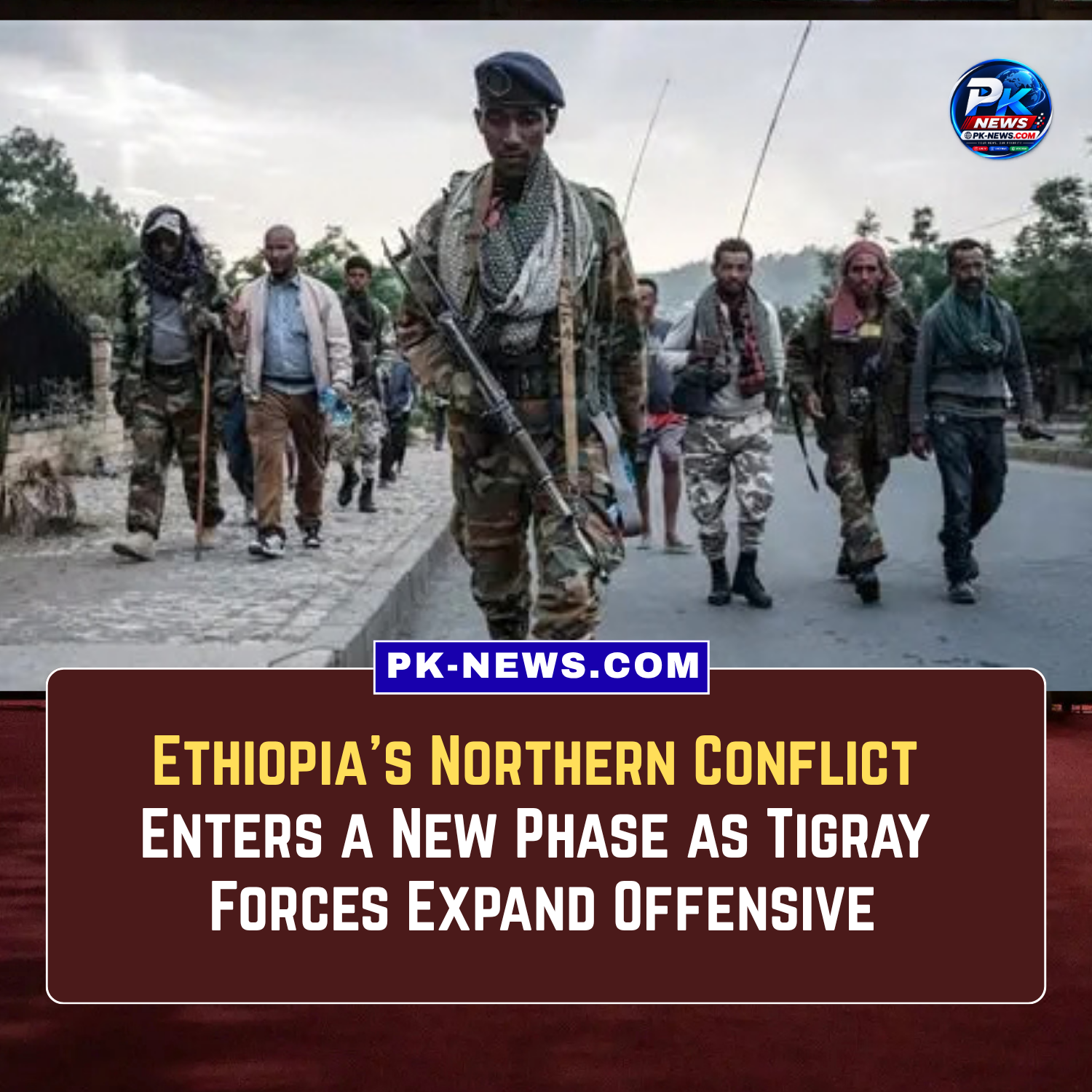
Ethiopia is facing a renewed security crisis after Tigrayan forces launched attacks in northern regions and a newly formed alliance of seven armed groups declared its intention to challenge Prime Minister Abiy Ahmed’s government. The escalation has raised concerns about the future of the 2022 peace agreement, regional stability and the possibility of a wider conflict involving neighbouring countries. This PK News report examines the latest developments, the groups involved and what could happen next.
PK-News.com
Ethiopia Faces Renewed Conflict as Tigray Fighting Spreads
ADDIS ABABA, September 24, 2026 — PK News: Ethiopia is experiencing its most serious security escalation in several years after fighting involving Tigrayan forces and the federal government intensified across parts of the country's north. The latest clashes come only days after seven armed groups announced a new coalition seeking to remove Prime Minister Abiy Ahmed's government and establish a transitional political arrangement.
The developments have revived concerns about the fragile peace that followed Ethiopia's devastating 2020–2022 Tigray war. The conflict between the Ethiopian federal government and the Tigray People's Liberation Front (TPLF) caused enormous human suffering and was formally brought to an end by the Pretoria peace agreement in November 2022. However, political and territorial disputes remained unresolved.
According to recent reports, fighting has now expanded beyond Tigray into neighbouring Afar and Amhara regions. Tigrayan forces have reportedly taken control of several locations and airports, while Ethiopian federal forces have responded with military operations. Ethiopian Airlines has also suspended flights to parts of Tigray because of the deteriorating security situation.
New Alliance Brings Former Rivals Together
One of the most significant developments is the creation of the Ethiopian Peoples' Forces Alliance for Survival, a coalition involving seven armed groups from different parts of Ethiopia.
The alliance includes the TPLF and the Amhara Fano National Movement, groups that previously fought on opposite sides during the Tigray conflict. Other participating movements are linked to regions including Oromia, Afar and Benishangul-Gumuz.
The coalition says it wants to challenge the federal government's political system and establish a transitional government. Reuters reported that the groups have accused the government of concentrating power at the centre and marginalising regional interests.
The alliance is significant because its members have historically had different political objectives and, in some cases, have fought against one another. Their decision to cooperate therefore represents a major change in Ethiopia's political and military landscape.
Analysts cited by Reuters have also cautioned that cooperation could be complicated by geographical distance, political differences and unresolved territorial disputes among some of the participating groups.
Fighting Moves Beyond Tigray
The latest military escalation is not limited to the Tigray region.
Reports indicate that Tigrayan forces have launched operations in neighbouring Afar and Amhara. The situation around the Tigray-Afar border has become particularly important, with reports of fighting around Abala and other locations.
There have also been reports of clashes around Weldiya in Amhara, an area that sits along an important route toward central Ethiopia.
The Ethiopian federal military has claimed significant battlefield gains, including saying that hundreds of Tigrayan fighters were killed. However, those casualty figures have not been independently verified, and there is limited reliable information about civilian casualties and losses among federal forces.
Tigrayan representatives, meanwhile, have described the situation as a major war and accused federal forces of beginning a large-scale offensive. Ethiopian government representatives have offered a different account, accusing TPLF forces of initiating attacks.
Because both sides are providing competing descriptions of events, the precise sequence of military operations remains difficult to independently establish.
The Pretoria Peace Agreement Under Pressure
The renewed fighting represents a major challenge for the 2022 Pretoria Agreement, which ended the previous Tigray war.
The agreement created a framework for ending hostilities between the federal government and the TPLF. It reduced large-scale fighting but did not resolve every major political and territorial dispute.
Tensions gradually increased again, particularly over political control in Tigray and unresolved territorial questions involving western Tigray and neighbouring Amhara.
The latest military escalation has therefore created questions about whether the peace framework can still prevent a much wider conflict.
The African Union has called for restraint and renewed dialogue, while the European Union has also urged immediate de-escalation and a return to the commitments made under the Pretoria agreement.
Eritrea Adds a Regional Dimension
Ethiopia's crisis also has an important regional dimension because of its complicated relationship with Eritrea.
Eritrea fought alongside Ethiopian government forces during the previous Tigray conflict, but relations between Asmara and Addis Ababa have subsequently deteriorated.
The Ethiopian government has accused Eritrea of supporting armed groups involved in the new opposition alliance. Eritrea has repeatedly denied similar accusations.
The dispute is particularly sensitive because Ethiopia has been seeking greater access to the Red Sea, while Eritrea is concerned about Ethiopian intentions toward its territory and coastline.
Any direct involvement by Eritrea could potentially make an already complicated Ethiopian conflict more difficult to contain. However, there is currently no independently verified evidence establishing that Eritrea has directly entered the latest fighting.
Why the New Coalition Matters
The new alliance is important not simply because of its size, but because it connects several separate conflicts inside Ethiopia.
For years, violence in Tigray, Amhara and Oromia has largely developed along separate political and ethnic lines. The new coalition creates an attempt to coordinate these movements against the federal government.
However, the groups do not necessarily share identical political objectives.
Their disagreements include questions about territory, regional autonomy, political representation and Ethiopia's future constitutional structure. These differences could become more significant if the coalition attempts to operate as a unified political and military organisation.
Al Jazeera reported that the alliance's stated objective includes removing Abiy's government, establishing a transitional government, conducting constitutional discussions and eventually moving toward elections.
Humanitarian Concerns
The renewed fighting also raises serious humanitarian concerns.
Tigray continues to deal with the consequences of the previous war, while hundreds of thousands of people remain displaced. A new escalation could force additional populations to leave their homes and place further pressure on humanitarian organisations.
The wider Horn of Africa is already facing major instability because of the war in neighbouring Sudan, political tensions between regional governments and continuing disputes surrounding the Red Sea.
A larger Ethiopian conflict could therefore have consequences extending beyond Ethiopia's borders.
What Could Happen Next?
The immediate future will depend heavily on whether the federal government and the armed groups choose military escalation or return to negotiations.
Three developments will be particularly important to watch:
First, whether fighting remains concentrated in northern Ethiopia or spreads to additional regions.
Second, whether the seven-group alliance maintains its cooperation despite differences among its members.
Third, whether the African Union, neighbouring governments and international partners can encourage direct negotiations before the conflict expands further.
For now, Ethiopia remains in a highly uncertain situation. The latest fighting does not by itself establish that the country has entered another conflict on the same scale as 2020–2022, but the geographic expansion of hostilities and creation of a broad armed coalition have significantly increased the risks.
The coming days could therefore be critical for determining whether Ethiopia moves toward another prolonged confrontation or finds a path back to political dialogue.
Developed for PK News | PK-News.com
56
Global
😔 Negative
Ethiopia’s Northern Conflict Enters a New Phase as Tigray Forces Expand Offensive
Related Articles You May Like
Related News








Comments (0)
Leave a Comment
No comments yet. Be the first to comment!