Addis Ababa — September 22, 2026 | PK News
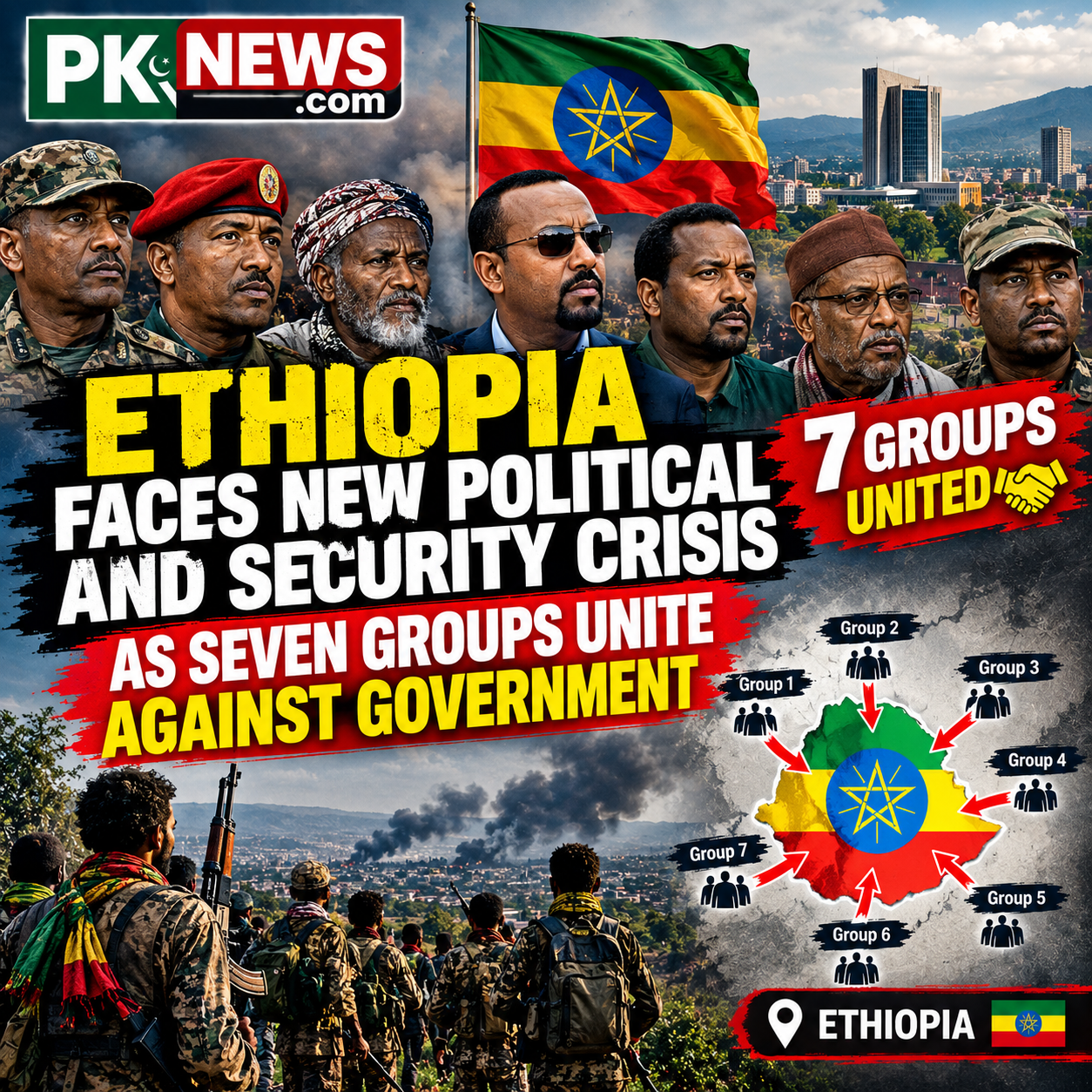
Ethiopia is facing renewed political and security tensions after seven armed and opposition groups announced a new alliance aimed at challenging Prime Minister Abiy Ahmed's government, raising concerns that the country could again experience a wider armed conflict.
The groups have presented themselves as a united front against what they describe as political marginalisation, inequality and failures to resolve longstanding disputes. Their announcement comes less than four years after the agreement that ended the devastating war in the northern Tigray region.
The development has attracted particular attention because several members of the new coalition have previously fought against one another or have had sharply different political objectives.
Seven Groups Join Forces
The new coalition is being described as an alliance for survival and brings together seven organisations with different ethnic, political and regional bases.
Among the most prominent are the Oromo Liberation Army (OLA), the Amhara Fano movement and the Tigray People's Liberation Front (TPLF).
They are joined by the Ogaden National Liberation Front (ONLF), the Far Revolutionary Democratic Unity Front, the Benishangul People's Liberation Movement and the Gumuz People's Democratic Movement.
The groups have accused the federal government in Addis Ababa of failing to address political grievances and of not adequately implementing previous agreements.
Their stated objective is to pressure or remove the current government and establish a transitional political arrangement.
However, members of the coalition have stressed different descriptions of their relationship. The TPLF, for example, has described the arrangement as a defensive or survival alliance rather than a formal military coalition.
A Coalition With Deep Internal Differences
One of the biggest questions surrounding the new alliance is whether organisations with such different histories can maintain a common strategy.
The groups have previously been on opposing sides of Ethiopia's conflicts.
The TPLF once dominated Ethiopia's federal political system before its relationship with the government deteriorated and fighting erupted in Tigray in 2020.
The Fano movement also has a complicated relationship with the federal government and has been involved in armed confrontation in the Amhara region.
The Oromo Liberation Army has separately been involved in an armed struggle with Ethiopian authorities.
These histories mean that opposition to the government may be the principal issue currently bringing the groups together.
Analysts quoted in the programme suggested that the alliance could therefore be more tactical than ideological.
The Tigray War Still Shapes Ethiopia's Politics
The new political development cannot be separated from Ethiopia's 2020–2022 conflict in Tigray.
The war caused enormous civilian suffering, mass displacement and destruction. Estimates of the death toll vary considerably, but researchers and international organisations have described the conflict as one of the world's most severe humanitarian crises during that period.
A peace agreement signed in Pretoria in November 2022 brought large-scale fighting to an end.
However, important disputes remained unresolved, including questions concerning territory, the return of displaced people, political authority and the future of armed forces.
The incomplete implementation of post-war arrangements has continued to influence relations between the federal government and political actors in northern Ethiopia.
TPLF's Position Adds Uncertainty
The TPLF's participation in the new alliance has attracted particular attention because the organisation itself has experienced internal divisions.
Some TPLF figures have continued working within Ethiopia's political system, while other factions have taken a more confrontational position toward the federal government.
The organisation has also had disagreements over the implementation of the 2022 peace agreement.
This makes it difficult to determine how far the entire TPLF leadership supports the latest alliance or what form its involvement could eventually take.
The coalition's long-term political programme also remains unclear.
Government Says Ethiopia Can Defend Itself
Prime Minister Abiy Ahmed's administration has sought to project confidence in the country's ability to deal with security threats.
The government has also promoted a national dialogue process intended to address political and social disputes.
Government officials have previously accused external actors of encouraging instability inside Ethiopia. Eritrea, which has repeatedly been mentioned in allegations concerning regional political and armed groups, has denied involvement in Ethiopia's internal affairs.
The Ethiopian government has not accepted the coalition's characterization of the country as being on the verge of disintegration.
This represents one of the central disagreements between Addis Ababa and the newly formed opposition alliance.
Foreign Powers and Regional Politics
Ethiopia's internal disputes are also connected to wider developments across the Horn of Africa.
The region has experienced overlapping conflicts and rivalries involving Ethiopia, Eritrea, Sudan, Somalia and other neighbouring states.
Relations between Ethiopia and Eritrea remain an important factor because the two countries have a complicated history, including their previous war and Eritrea's involvement during the Tigray conflict.
Sudan's continuing civil war has added another layer of regional instability.
Analysts have also pointed to the involvement or interests of countries including Egypt, Saudi Arabia and the United Arab Emirates in wider Horn of Africa politics. However, allegations concerning specific forms of support for the Ethiopian opposition groups remain disputed, and countries accused of involvement have denied such claims.
Could Ethiopia Return to War?
The formation of the alliance does not automatically mean that a new nationwide war will begin.
The organisations still face major questions about command structures, military coordination, political leadership and their competing visions for Ethiopia.
Several groups have armed wings, but the alliance has not publicly demonstrated a unified military structure.
Its members also disagree on fundamental questions about Ethiopia's political future, including federalism, regional autonomy, national identity and the distribution of political power.
Those differences could make sustained cooperation difficult.
At the same time, the existence of armed organisations with longstanding grievances means the announcement has significant security implications.
Civilians Remain at the Center of Concern
For ordinary Ethiopians, the possibility of another major conflict is particularly concerning.
The previous Tigray war displaced millions and created severe humanitarian needs. Ethiopia has also experienced violence and displacement in other regions.
Aid organisations continue to deal with food insecurity, displacement and the consequences of previous conflicts.
A return to large-scale fighting could put additional pressure on communities already struggling to recover.
The greatest concern is that political disagreements could once again develop into armed confrontations involving civilian areas.
Can Dialogue Prevent Escalation?
The African Union has previously played a major role in efforts to end Ethiopia's conflicts, including supporting the negotiations that produced the 2022 Pretoria agreement.
The organisation remains an important potential channel for diplomacy.
The Intergovernmental Authority on Development (IGAD) and international partners could also become involved if tensions escalate.
However, analysts quoted in the discussion argued that successful mediation would require the parties themselves to accept negotiations as an alternative to armed confrontation.
The United States is another potentially influential actor because of its diplomatic relationships with Ethiopia and several countries involved in wider regional politics.
What Happens Next?
The immediate challenge for Ethiopia will be determining whether the newly announced coalition remains primarily political or develops into a coordinated armed front.
The alliance's members will need to address their substantial ideological and historical differences if they intend to operate as a unified political movement.
Meanwhile, the federal government faces pressure to address grievances raised by opposition groups while maintaining security across the country.
Whether the current tensions lead to further conflict or renewed political negotiations will depend on developments in the coming weeks.
PK News Analysis
The formation of a seven-group alliance represents a significant new development in Ethiopia's complicated political landscape. The organisations share opposition to Prime Minister Abiy Ahmed's government, but they do not share identical political goals or histories.
The TPLF has described the arrangement as an alliance for survival and has disputed descriptions of it as a formal military alliance. Several other members, however, have armed wings and histories of conflict with the Ethiopian state.
The key questions now are whether the coalition can maintain unity, whether the Ethiopian government can prevent further escalation, and whether African and international mediators can encourage political negotiations.
For a country still recovering from the devastating Tigray conflict, renewed large-scale fighting could have serious humanitarian consequences.
This article has been independently rewritten and prepared for publication by PK-News.com from the supplied programme transcript and its reported information. It does not reproduce the original broadcast script.
PK News — PK-News.com | Africa • Ethiopia • Horn of Africa • World News
59
Global
😔 Negative
Ethiopia Faces New Political and Security Crisis as Seven Groups Unite Against Government
Related Articles You May Like
Related News








Comments (0)
Leave a Comment
No comments yet. Be the first to comment!