Islamabad is facing heightened security and serious traffic restrictions as authorities prepare for the Pakistan Tehreek-e-Insaf (PTI) mobilisation that had been planned for September 27. Major highways and entry routes have been blocked or restricted with containers, while thousands of security personnel have been prepared for deployment. The measures have affected transport, schools and daily life in the capital and surrounding areas. Although PTI has now reportedly postponed the march to October 4, the security arrangements remain a major developing story.
Islamabad enters a period of heightened security
Pakistan's federal capital has entered an unusual security phase as authorities continue preparations linked to the PTI's planned mobilisation.
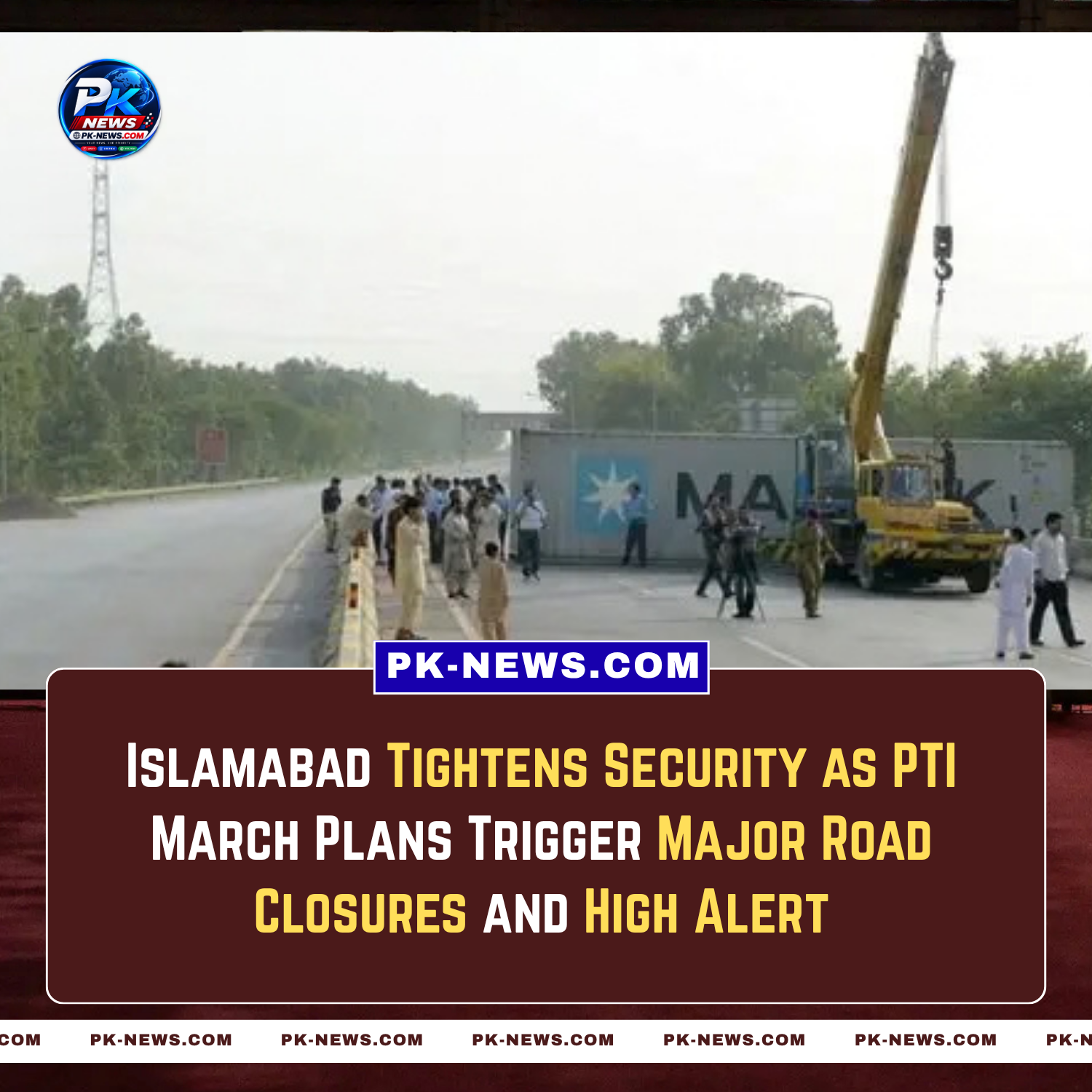
For several days, major roads approaching Islamabad have been restricted, while shipping containers and other barriers have been placed at important entry points.
The preparations were initially connected to PTI's September 27 long march, which the party had announced as a mobilisation demanding the release of former prime minister Imran Khan.
On September 25, however, reports emerged that PTI's political committee had decided to postpone the march until October 4. The Express Tribune reported that the party's leadership ultimately agreed to defer the protest after consultations.
Despite the reported postponement, security arrangements already put in place around the capital have become a major issue for residents, travellers and businesses.
Major highways face restrictions
One of the most visible consequences has been disruption to transportation.
The National Highways and Motorway Police has reported restrictions on several major routes leading toward Islamabad.
Reports published on September 25 said the M-1 motorway was closed in both directions between Swabi and the Islamabad Toll Plaza. Restrictions were also reported on parts of the E-35 Hazara Motorway and N-5/GT Road.
The closures have affected people travelling between Khyber Pakhtunkhwa, Punjab and Islamabad.
For commuters, the restrictions mean longer routes, traffic diversions and uncertainty about which roads remain accessible.
The situation has also raised concerns among transport operators because Islamabad is an important connection point for commercial traffic moving between northern Pakistan and other regions.
Containers used to block entry points
Authorities have used large shipping containers to restrict access to Islamabad.
According to AFP reporting carried by Business Recorder, approximately 22,000 security personnel had been deployed in Islamabad as authorities prepared for the planned demonstration. Major entry points, highways and intersections were obstructed by containers.
Images and reports from the capital showed double-stacked containers being used at strategic locations.
The Islamabad-Peshawar Motorway was among the routes affected.
The restrictions have created significant traffic congestion in areas where vehicles have been diverted onto alternative roads.
Security personnel prepared for deployment
The government has also increased the presence of security forces.
The federal government authorised the deployment of Pakistan Rangers in Islamabad Capital Territory and several Punjab districts.
According to a Ministry of Interior notification reported by Dawn, the deployment was authorised from September 20 until October 5.
The timing is significant because the newly reported October 4 date for the PTI march falls within this authorised deployment period.
Separately, reports have described preparations involving police personnel from different provinces.
Business Recorder reported that the Islamabad administration had taken control of more than 24 educational institutions for temporary accommodation of police and security personnel.
Schools affected by security preparations
The security situation has also reached educational institutions.
According to Business Recorder, more than 24 schools and colleges under the Federal Directorate of Education were temporarily handed over to the Islamabad administration and police to accommodate security personnel.
Students and teachers at the affected institutions were given holidays, with classes shifted online.
The report also stated that the federal government had not announced a blanket closure of all schools and colleges across Islamabad.
This distinction is important because not every educational institution in the capital has necessarily been closed.
The decision to use selected institutions for security accommodation demonstrates the scale of preparations taking place ahead of the political mobilisation.
Businesses and transport also feel pressure
The restrictions have broader economic consequences.
Transporters have warned that road closures and vehicle restrictions are affecting freight movement.
Arab News Pakistan reported that transporters had raised concerns about supply chains, while the government was considering contingency arrangements to keep fuel supplies moving if road restrictions continued.
Commercial traffic is particularly important for Islamabad and Rawalpindi because the twin cities receive goods from multiple parts of the country.
Extended road restrictions can therefore affect restaurants, shops, fuel stations, logistics companies and other businesses.
For ordinary citizens, even short-term closures can increase commuting times and transportation costs.
Political background
The security measures are connected to a wider political dispute between PTI and the federal government.
PTI had announced the Islamabad march while demanding the release of Imran Khan and raising broader political demands.
The government, meanwhile, has said that public order and citizens' movement must be protected.
The Islamabad High Court has also addressed the issue.
In a detailed judgment reported by Geo News, the court stated that political parties do not have a lawful right to occupy public roads, highways, interchanges, toll plazas or government buildings. The judgment also addressed the protection of citizens' fundamental rights and the responsibilities of authorities during political protests.
These legal considerations form part of the background to the current security arrangements.
Conflicting information about road access
There has also been controversy over whether all roads into Islamabad remained open.
A September 24 fact-check by The Express Tribune challenged a statement attributed to State Minister for Interior Talal Chaudhry that all 125 roads leading to Islamabad were open.
The fact-check said major routes including the M-1, M-14 and N-5/GT Road remained closed or restricted.
This illustrates the difficulty for travellers trying to determine which routes are currently available.
Because road conditions can change quickly during security operations, commuters have been advised through official traffic and motorway channels to check the latest information before travelling.
What happens after the reported postponement?
The reported postponement of the PTI march changes the immediate situation but does not automatically end the security concerns.
If October 4 becomes the confirmed new date, authorities may continue some security arrangements through the following week.
The existing Rangers authorisation reportedly runs through October 5, meaning the new reported protest date falls almost exactly at the end of the current authorisation period.
The government could therefore reassess its strategy in the coming days.
PTI, meanwhile, will need to communicate its revised mobilisation plan to supporters and clarify whether the route, timing and demands will remain unchanged.
Islamabad residents await normal movement
For residents of Islamabad and Rawalpindi, one of the most important questions is when normal traffic will return.
The road restrictions have affected daily commuting, intercity travel and commercial activity.
If restrictions remain in place for an extended period, pressure could increase on alternative roads and public transport.
Businesses located around major entry points could also continue experiencing reduced customer movement.
The situation therefore extends beyond the political dispute itself and directly affects ordinary residents.
A developing story for Pakistan
Islamabad's security situation remains one of Pakistan's most closely watched developments on September 25, 2026.
The combination of road closures, container barriers, security-force deployment and disruption to selected educational institutions has created an unusual environment in the capital.
At the same time, PTI's reported decision to postpone the march from September 27 to October 4 means the situation could change again in the coming days.
The exact timeline for reopening roads, removing containers and reducing security deployments remains subject to decisions by the authorities.
For now, travellers and residents should rely on updated official traffic and administrative announcements because access routes can change rapidly.
PK-News.com will continue following the Islamabad security situation and will publish further updates as PTI, the federal government and local authorities announce new developments.
179
Politics
😐 Neutral
Islamabad Tightens Security as PTI March Plans Trigger Major Road Closures and High Alert
Related Articles You May Like
Related News






Comments (0)
Leave a Comment
No comments yet. Be the first to comment!