305
Global
😔 Negative
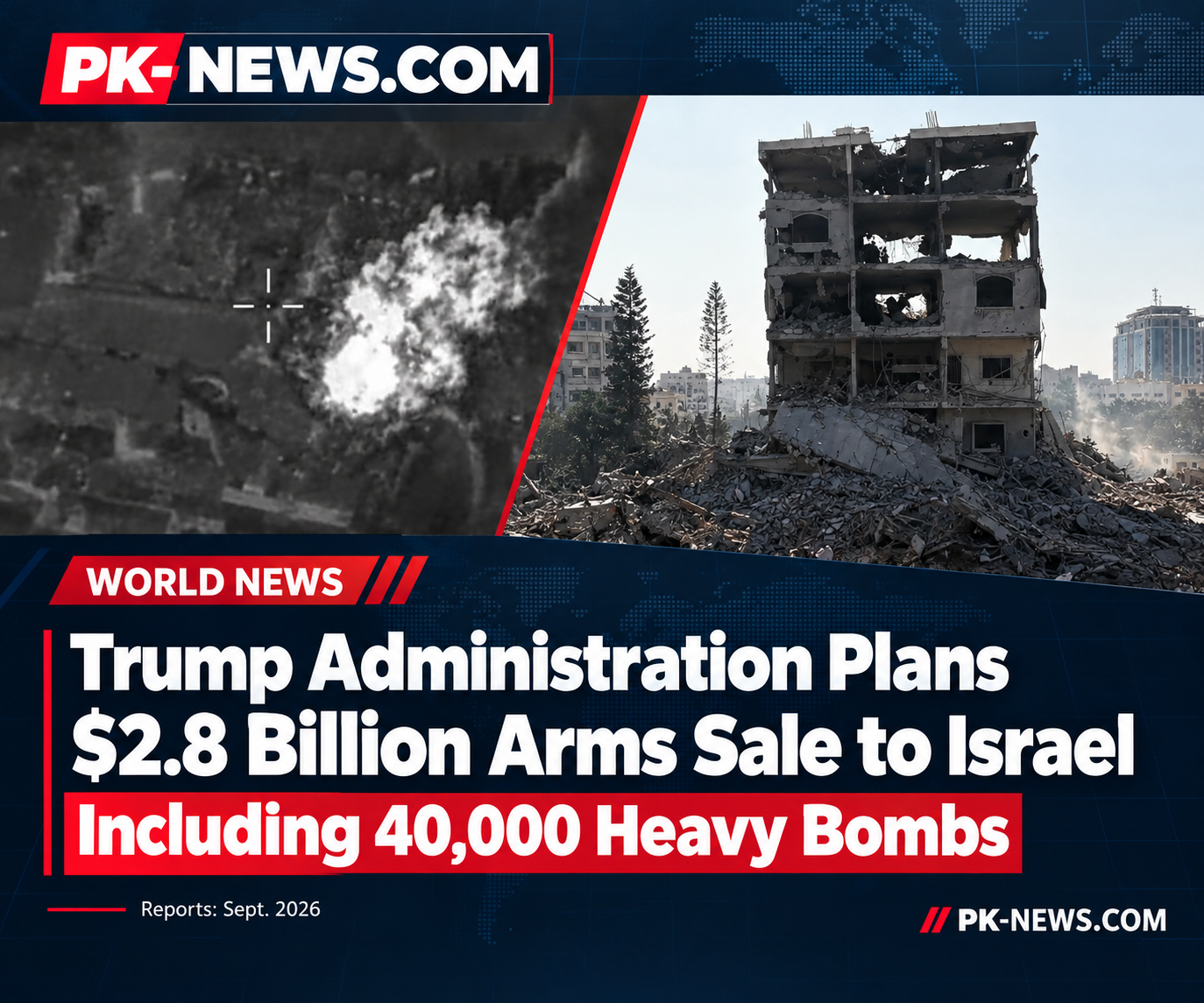
Trump Administration Plans $2.8 Billion Arms Sale to Israel Including 40,000 Heavy Bombs
By Muhammad Ibraheem | PK News
The Trump administration is preparing a major new weapons package for Israel worth approximately $2.8 billion, including 40,000 2,000-pound bombs, according to U.S. officials familiar with the proposed deal.
The planned package would represent one of the largest U.S. transfers of heavy bombs to Israel in recent years and comes as Washington continues to provide military support to its Israeli ally amid the continuing conflict and international debate over the humanitarian consequences of the fighting.
The proposed transaction has already attracted attention in Congress, where lawmakers are examining the potential sale and the conditions under which the weapons would be transferred.
What Is Included in the Proposed Package?
According to reporting by The Associated Press and The Washington Post, the package includes 40,000 bombs weighing 2,000 pounds each.
The weapons are divided into two major categories:
20,000 MK-84 bombs
20,000 BLU-117 bombs
The proposed package also includes 20,000 I-2000 penetrator warheads, which are designed for use against hardened and underground targets.
The weapons would be supplied through the U.S. Foreign Military Financing system, under which American financing can be used by partner countries to purchase U.S.-made military equipment. Most of the proposed package would be financed through that mechanism.
Why Are 2,000-Pound Bombs Significant?
The MK-84 and related 2,000-pound-class bombs are among the largest conventional aerial bombs in the U.S. inventory.
Different versions can be used against different types of targets. Some are intended for conventional targets, while penetrator weapons are designed to reach hardened or underground structures.
Their large explosive payload also means that their use in densely populated areas can create significant risks to surrounding buildings and civilians. This has been one of the main concerns raised by lawmakers and human-rights organizations regarding the proposed transfer.
The Biden administration previously paused a shipment of some 2,000-pound bombs to Israel in 2024 amid concerns about their potential use in densely populated areas of Gaza. The Trump administration subsequently lifted that hold after returning to office.
Congressional Review
The proposed sale has been informally communicated to congressional committees.
Congressional leaders have an opportunity to review major U.S. arms sales, although the administration has previously used emergency provisions to bypass the ordinary review process for certain weapons transfers.
On September 16, Representative Gregory Meeks, the top Democrat on the House Foreign Affairs Committee, said he would not approve the proposed sale at this stage.
Meeks said the administration had not provided sufficient assurances regarding how the weapons would be used and whether appropriate protections for civilians would be maintained. His objection alone does not necessarily prevent the administration from proceeding with the proposed transaction.
The administration could potentially invoke emergency authority under U.S. arms-control law to move a sale forward without completing the ordinary congressional review period.
Previous U.S. Weapons Transfers to Israel
The proposed $2.8 billion package follows several major U.S. weapons transfers to Israel during the Trump administration.
In 2025, the administration approved a nearly $3 billion sale that included more than 35,000 bombs of the same general 2,000-pound class.
The administration also approved additional arms sales to Israel totaling approximately $6.67 billion in January 2026, according to reporting by AP and other outlets.
The new proposal therefore represents another major step in continued U.S. military support for Israel.
Concerns Over Gaza and Lebanon
The proposed sale comes against the backdrop of the continuing conflict involving Israel, Hamas and other armed groups in the region.
The use of large aerial bombs in densely populated areas has become a major point of international debate because of the potential for civilian casualties and widespread damage to buildings and infrastructure.
U.S. officials and Israeli authorities have maintained that heavy weapons can be used against military targets, including underground tunnels and hardened positions.
Critics of the proposed sale argue that the size and destructive capability of the weapons require stronger safeguards when they are used in areas where civilians are present.
Representative Meeks specifically cited concerns about the possible use of the weapons in densely populated parts of Gaza and Lebanon.
The U.S.-Israel Military Relationship
The proposed weapons package also highlights the continuing strength of the U.S.-Israel military relationship.
Although President Donald Trump and Israeli Prime Minister Benjamin Netanyahu have experienced disagreements over aspects of regional policy and the handling of conflicts, Washington continues to provide substantial military assistance to Israel.
The latest proposed package indicates that those disagreements have not resulted in a major reduction in U.S. military support.
The timing is also significant because the region remains unstable, with conflicts and military tensions extending beyond Gaza.
The Sale Is Not Yet Final
Despite reports about the planned package, the deal should not be described as a completed weapons transfer.
U.S. officials familiar with the proposal said the package was still being developed, while congressional committees had been informally notified.
The State Department has also generally declined to discuss proposed arms sales before formal notification and completion of the relevant procedures.
This means the final terms, timing and delivery schedule could still change.
Why the Deal Matters
The proposed $2.8 billion package is significant for several reasons.
First, the number of heavy bombs involved is unusually large. Second, the weapons are being proposed at a time when the use of large munitions in Gaza and Lebanon remains highly controversial.
Third, the deal has become a subject of congressional debate, demonstrating that U.S. military assistance to Israel remains politically sensitive in Washington.
The proposal also illustrates the broader challenge facing the United States as it balances support for an important military ally with congressional and international concerns over civilian protection and the use of American-made weapons.
What Happens Next?
The next stage will involve the formal congressional notification and review process.
Lawmakers can raise objections and seek additional information about the proposed weapons transfer. However, the administration has previously used emergency authorities to accelerate arms sales to Israel.
The final outcome will therefore depend on the administration's actions, congressional oversight and the legal procedures governing the proposed transaction.
For now, the reported package remains a planned $2.8 billion arms sale, rather than a completed delivery.
Key Facts
Package value: Approximately $2.8 billion
Country receiving weapons: Israel
Bombs: 40,000
Bomb weight: 2,000 pounds each
MK-84 bombs: 20,000
BLU-117 bombs: 20,000
Additional penetrator warheads: 20,000 I-2000
Financing: U.S. Foreign Military Financing
Status: Proposed / pending congressional process
Reported date: September 2026
The proposed weapons sale is now likely to remain under close scrutiny in Washington as lawmakers consider the military, legal and humanitarian implications of transferring thousands of large bombs to Israel.
Source basis: Reporting from The Associated Press, Reuters and The Washington Post, with the latest developments dated September 15–16, 2026.
Published by: PK News
Author: Muhammad Ibraheem
Related Articles You May Like
Related News










Comments (0)
Leave a Comment
No comments yet. Be the first to comment!