Islamabad — September 24, 2026 | PK-News.com
A powerful phrase has been circulating widely in Pakistan amid the country's latest political tensions:
“To keep one man in prison, the whole country had to be turned into a jail.”
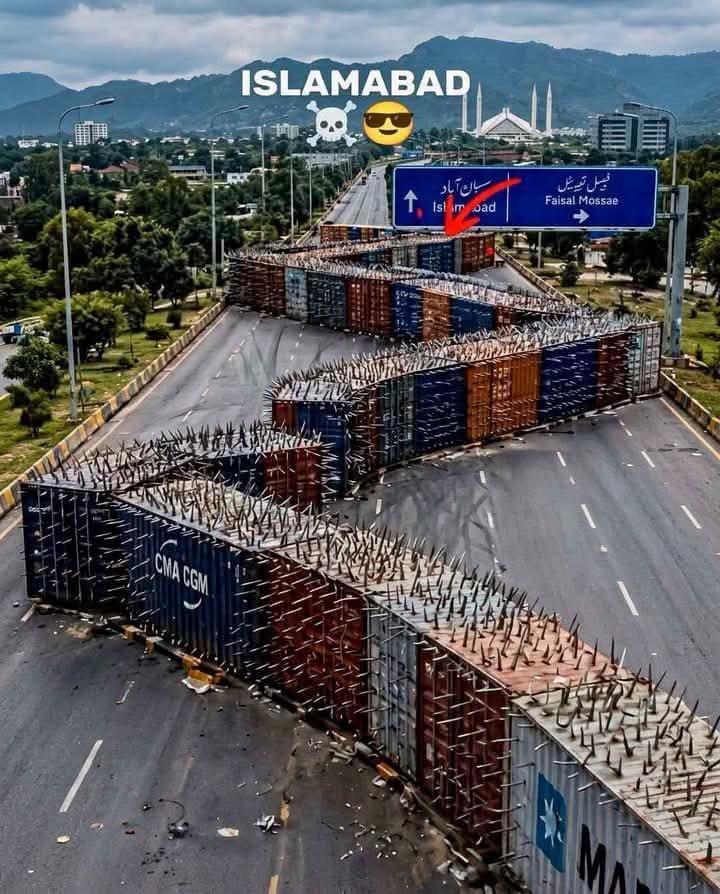
The statement is political commentary rather than a legal description. However, recent events have given the phrase renewed attention. Restrictions on public gatherings, arrests of family members of former Prime Minister Imran Khan, heightened security measures and preparations ahead of a planned Pakistan Tehreek-e-Insaf (PTI) protest have created a political environment in which the dispute surrounding one imprisoned political leader is increasingly affecting public life beyond the walls of Adiala Jail.
PK-News.com reviewed recent government orders, reported developments and statements from the major sides involved to examine how the situation has developed and why the phrase has become part of the wider political debate.
Imran Khan Remains in Adiala Jail
Former Prime Minister and PTI founder Imran Khan remains incarcerated at Rawalpindi's Adiala Jail. His imprisonment has continued to be one of Pakistan's most significant political issues, with PTI repeatedly demanding his release and raising concerns about access to family members and political representatives.
The issue has also extended beyond Khan himself. His relatives and supporters have remained publicly involved in efforts connected to his legal and political situation.
Recent developments have again placed the question of access to Khan and the treatment of people campaigning for his release at the centre of political discussion.
Arrests of Imran Khan's Sisters
The situation intensified in September after authorities detained Imran Khan's sister Aleema Khan in Lahore.
According to reporting by Dawn, Lahore's deputy commissioner ordered her detention for 30 days under the Punjab Maintenance of Public Order Ordinance. The detention came ahead of PTI's planned September 27 protest and march to Islamabad.
The situation developed further when Imran Khan's other sisters, Dr Uzma Khan and Noreen Niazi, were also detained for 30 days under the same legal framework, according to Dawn.
Reuters separately reported that Aleema Khan's detention was ordered amid government concerns about public safety ahead of the planned PTI demonstration. Government officials have said measures are necessary to prevent disorder, while PTI has criticized the arrests.
The arrests therefore became another major part of the political dispute surrounding Imran Khan's imprisonment.
Section 144 Imposed in Islamabad
One of the most significant recent developments came with the enforcement of Section 144 in Islamabad.
According to the Islamabad administration's order reported by Dawn, Section 144 has been imposed for two months. The order prohibits gatherings of five or more people, as well as processions, rallies and demonstrations in public places within Islamabad, including the Red Zone.
The administration said the restrictions were introduced because of concerns about planned assemblies and possible threats to public peace, safety and property.
The timing is particularly important because PTI has announced a September 27 march to Islamabad demanding Imran Khan's release.
Punjab has also imposed Section 144 for a separate period of 13 days, while authorities have requested additional security arrangements in districts including Rawalpindi, Attock, Jhelum and Mianwali.
Roads, Security and Possible Internet Restrictions
The preparations have not been limited to legal restrictions.
Authorities have increased security arrangements around Islamabad and Rawalpindi. Reports have also emerged regarding road closures and possible restrictions on mobile and internet services in specific areas during the expected protests.
Dawn reported that the Punjab government requested Rangers deployment in several districts and that the provincial Home Department asked the federal government to consider downgrading or suspending mobile and internet services at specific locations on September 27 because of the expected law-and-order situation.
Islamabad police have also issued traffic advisories, including warnings concerning travel on the Islamabad-Peshawar motorway as preparations for the anticipated demonstrations continue.
These measures mean that the political dispute is no longer confined to political meetings or courtrooms. It is increasingly affecting transportation, public gatherings, security deployment and potentially communications.
The Government's Position
The government has presented the restrictions as security and law-and-order measures.
Officials have warned that violent groups will not be permitted to enter Islamabad or block roads. The government has also pointed to the possible economic and public-safety consequences of large demonstrations.
Information Minister Attaullah Tarar has said the government will not allow groups to disrupt public movement or block roads. Other government officials have also warned about the potential economic cost of prolonged protests.
From the government's perspective, the central issue is maintaining public order and protecting people, businesses, roads and public property.
PTI's Position
PTI has presented the situation differently.
The party says its planned protest is intended to demand Imran Khan's release and assert what it describes as constitutional and political rights.
Khyber Pakhtunkhwa Chief Minister Sohail Afridi has publicly argued that staging protests is a legal and constitutional right.
PTI leaders have also criticized the arrests of Khan's family members and the restrictions placed on political activity.
The Islamabad High Court, meanwhile, has stated that political parties and their leadership do not have a lawful right to occupy public roads, highways, interchanges, toll plazas or buildings in ways that obstruct access to essential services and institutions.
This highlights the central legal tension: the right to political expression and peaceful assembly exists alongside restrictions intended to protect public safety and the rights of other citizens.
Why the “Whole Country Is a Jail” Phrase Is Trending
The phrase “To keep one man in prison, the whole country had to be turned into a jail” is not an official government statement or legal finding.
It is a political expression describing the perception that extraordinary restrictions are being introduced because of a political dispute centred on one imprisoned leader.
The facts behind the debate are clear: Imran Khan remains imprisoned; members of his family have been detained; PTI has announced a major protest; Section 144 has been imposed in Islamabad; Punjab has also introduced restrictions; additional security forces have been requested; and authorities are preparing for possible disruption.
Whether these measures should be understood primarily as necessary security precautions or as excessive restrictions on political activity is a matter on which the government, PTI, lawyers and rights organizations have different positions.
The Bigger Question for Pakistan
The current situation raises a broader question about the balance between political protest and public order.
Governments have a responsibility to protect citizens and public property, particularly when large demonstrations are expected. At the same time, political parties and citizens have rights to political expression and peaceful assembly subject to the law.
The challenge is determining where legitimate security measures end and unnecessary restrictions begin.
For ordinary citizens, the consequences can be practical. Road closures can affect travel. Restrictions on gatherings can affect businesses and political activities. Security checkpoints can change movement patterns, while possible communications restrictions could affect people who are not directly involved in political activity.
This is why the debate surrounding Imran Khan has become much larger than the question of one prisoner.
What Happens Next?
The next major point is September 27, when PTI has announced its planned march and protest in Islamabad.
Authorities have already imposed restrictions and increased security preparations, while PTI leaders continue to call for political mobilization.
The situation could therefore develop further depending on whether the protest takes place, how authorities respond, and whether negotiations or legal interventions change the current arrangements.
PK-News.com's research indicates that the current political dispute has expanded well beyond Adiala Jail.
It now involves arrests, courts, political parties, public gatherings, highways, security deployments and potentially telecommunications.
The phrase “To keep one man in prison, the whole country had to be turned into a jail” should therefore be understood as a political characterization of these developments—not as a literal description of Pakistan's legal system.
But the underlying question remains significant:
How far should a state go to prevent political unrest, and how can it maintain public order without unnecessarily restricting the political and civic freedoms of ordinary citizens?
As Pakistan approaches September 27, the answer will depend not only on the actions of the government and PTI, but also on how courts, security institutions and citizens respond to the rapidly changing political situation.
This article is based on PK-News.com's review of recent reported developments and publicly available statements. Political claims and interpretations have been attributed to the relevant parties rather than presented as established facts.
765
Politics
😐 Neutral
To Keep One Man in Prison, Did Pakistan Have to Turn the Whole Country Into a Jail?
Related Articles You May Like
Related News





Comments (0)
Leave a Comment
No comments yet. Be the first to comment!