Doha — September 22, 2026 | PK News
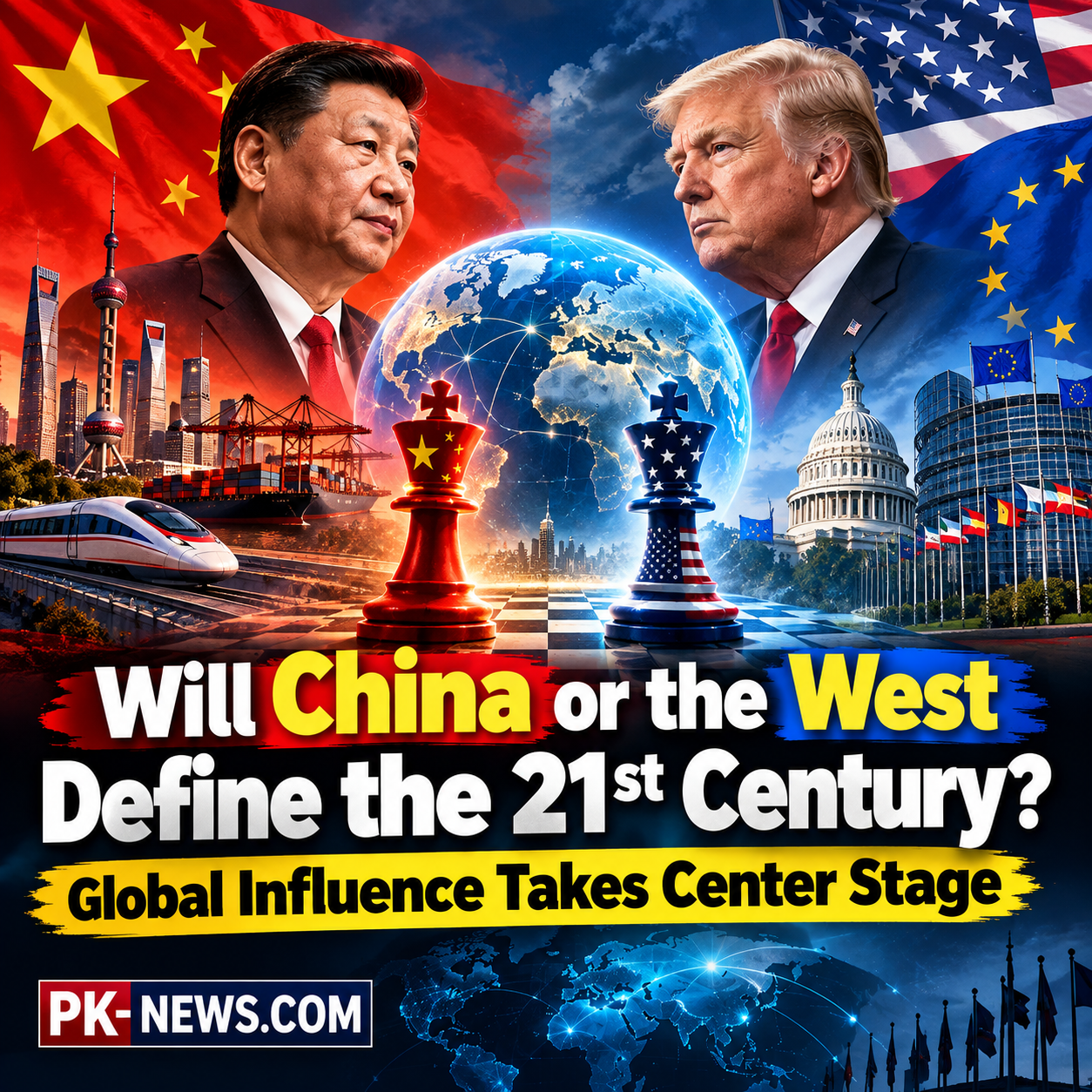
The growing competition between China and Western powers is reshaping debates over the future of the international system, with questions increasingly focused on whether the 21st century will be defined by continued Western influence, China’s rise, or a more fragmented and multipolar world.
A recent Doha Debates discussion brought together experts with different perspectives on China’s global role, Western influence, international law, human rights, economic development and the future of global governance.
The discussion highlighted the significant expansion of China’s economic and diplomatic influence over recent decades. Participants pointed to China’s extensive trade relationships, infrastructure investment and growing engagement with countries across the Global South as important elements of its international presence.
Henry Wang, a former counselor of China’s State Council, argued that China’s development model and long-term planning have helped transform its economy and reduce poverty on a huge scale. He presented China as a supporter of multilateral institutions and argued that Beijing seeks a more cooperative international system rather than replacing the existing global order with a single dominant power.
Other participants challenged parts of that interpretation. They argued that China’s growing economic influence does not necessarily mean that other countries are adopting the Chinese political model. They also raised questions about China's approach to territorial disputes, human rights and the application of international rules.
The debate also examined the Western-led rules-based international order established after World War II. Participants noted that institutions such as the United Nations and international law were designed to create common rules for states and reduce the risk of major-power conflict.
Critics of Western policy argued that Western governments have sometimes applied international principles inconsistently, pointing to military interventions and different responses to conflicts around the world. Others maintained that the existence of violations by powerful states does not invalidate the underlying international legal framework.
The war in Ukraine became another major point of disagreement. Wang said China supports Ukraine’s sovereignty and territorial integrity while also emphasizing the wider security architecture surrounding the conflict. Other speakers questioned why Beijing has not explicitly condemned Russia’s invasion.
China’s position in the Global South was also discussed. Some participants argued that countries outside the traditional Western sphere are increasingly seeking greater independence in international affairs rather than simply choosing between Washington and Beijing.
The discussion ultimately moved beyond the question of whether China or the West should dominate. Several participants emphasized the possibility of a multipolar international system, in which major powers, middle powers and developing countries all have greater influence.
Climate change emerged as another major challenge. Speakers argued that the scale of climate-related risks requires international cooperation that goes beyond geopolitical competition. China’s role in developing and manufacturing climate technologies was also highlighted during the discussion.
The debate reflected a broader transformation in global politics: China has become a major economic and diplomatic power, while Western influence remains substantial but faces increasing challenges. Rather than producing a simple transfer of power from one side to another, the changing balance could lead to a more complex international system in which cooperation, competition and disagreement coexist.
The central question for the coming decades may therefore be less about whether China or the West completely defines the 21st century, and more about how both interact with a growing number of influential countries in an increasingly multipolar world.
6
Global
😐 Neutral
Will China or the West Define the 21st Century? Global Influence Takes Center Stage
Related Articles You May Like
Related News







Comments (0)
Leave a Comment
No comments yet. Be the first to comment!