Pakistan Prime Minister Shehbaz Sharif has issued a strong warning at the 81st United Nations General Assembly, saying any attempt to stop, impede or divert Pakistan’s share of the Indus River waters would be treated by Pakistan as an “act of war.” His remarks came amid continuing disagreement between Islamabad and New Delhi over the Indus Waters Treaty, while India maintains its own position on the treaty and links its continued suspension to concerns over cross-border terrorism.
According to PK-News.com | September 26, 2026
Pakistan-India tensions over the Indus river system have once again moved into the international spotlight after Prime Minister Shehbaz Sharif delivered a strongly worded warning during his address to the United Nations General Assembly in New York.
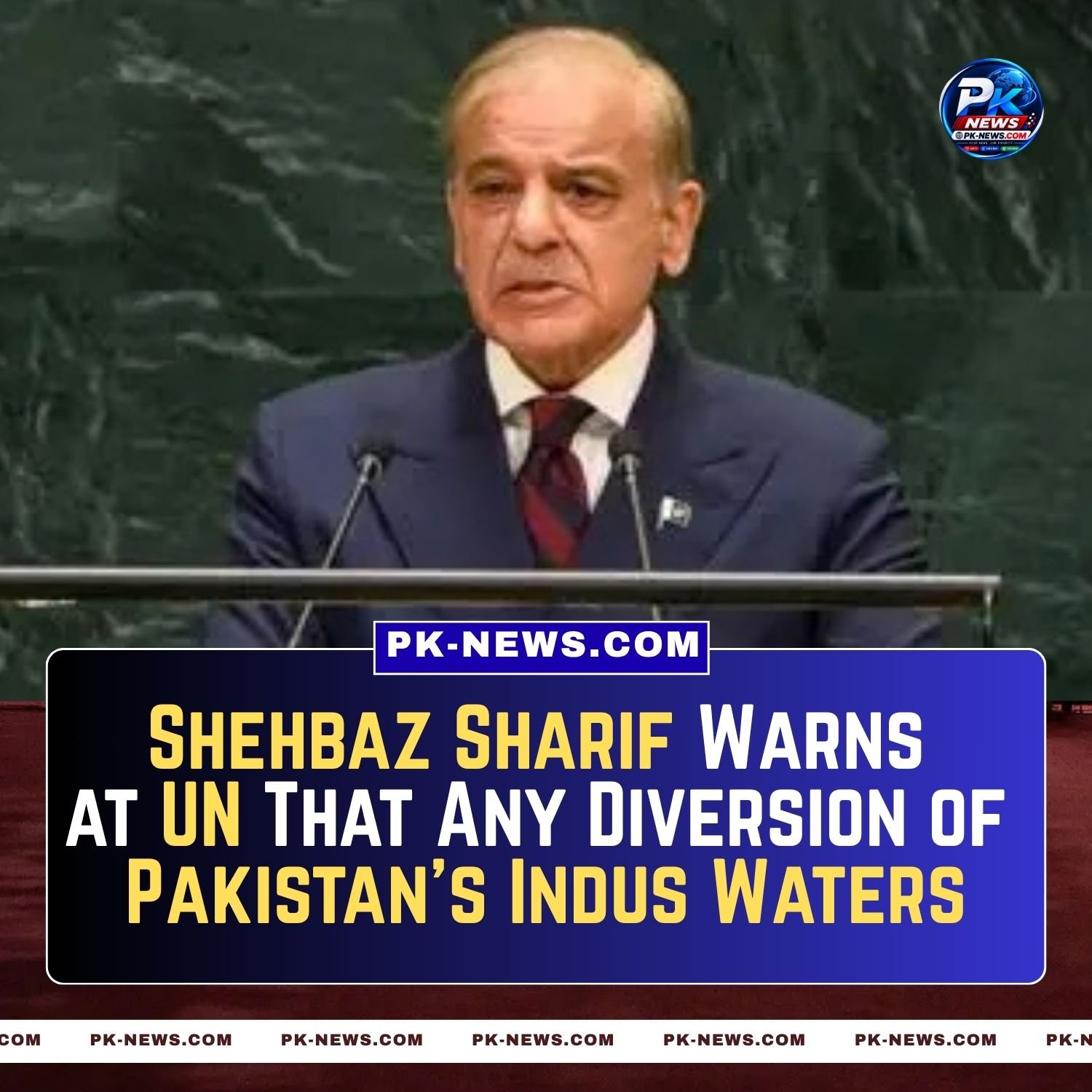
Speaking at the 81st session of the UNGA on September 25, Sharif said Pakistan would regard any attempt to stop, impede or divert its share of the waters of the Indus River system as an “act of war.”
The statement has placed the long-running dispute over the Indus Waters Treaty (IWT) at the centre of renewed diplomatic tensions between the two nuclear-armed neighbours.
Sharif's Warning at the United Nations
During his address, Sharif described the Indus river system as vital not only for Pakistan but for the wider region.
He said water should not be used as an instrument of political pressure and argued that rivers should serve the people of the region rather than become another source of confrontation.
The Pakistani prime minister specifically objected to India's decision to place the Indus Waters Treaty in abeyance.
Sharif said Pakistan considered the Indian decision to have no legal basis and argued that the treaty remained valid and binding.
His remarks represent one of the strongest recent public statements from Pakistan concerning the future of the Indus river system.
What Is the Indus Waters Treaty?
The Indus Waters Treaty was signed by India and Pakistan in 1960 with the World Bank playing a role in facilitating the agreement.
The treaty established a framework for managing the waters of the Indus river system.
Broadly, the agreement allocated the eastern rivers — Ravi, Beas and Sutlej — for India's unrestricted use, while the western rivers — Indus, Jhelum and Chenab — were primarily allocated to Pakistan, subject to provisions allowing India certain uses.
For Pakistan, the western rivers are particularly important because the country's agriculture, water supply and wider economy depend heavily on the Indus basin.
The treaty has survived several major periods of tension between India and Pakistan, making the current dispute particularly significant.
Why the Treaty Is in Dispute
India placed the treaty in abeyance in April 2025 following the Pahalgam attack that killed 26 people.
New Delhi has maintained that the suspension will remain in place until Pakistan credibly and irrevocably ends its support for cross-border terrorism. India has also challenged the jurisdiction of an arbitration process established under the treaty.
Pakistan rejects India's position and has continued to maintain that the treaty remains legally valid.
Sharif reiterated that position during his UN speech.
The disagreement therefore involves both water management and broader security and diplomatic disputes between the two countries.
India Responds to Pakistan's Position
India has rejected Pakistan's framing of the dispute.
Indian officials have linked the treaty issue to terrorism concerns and have warned Pakistan against what New Delhi describes as support for cross-border militant activity.
Following Sharif's UN address, Indian officials again criticized Pakistan's statements concerning terrorism and regional security.
Indian Express reported that India warned Pakistan of “consequences” in response to the Pakistani government's statements, while presenting its own allegations concerning terrorism and violence. Those claims are disputed by Pakistan.
The competing positions demonstrate that the water dispute cannot easily be separated from the wider political and security relationship between the two countries.
Why the Issue Matters to Pakistan
The Indus basin is fundamental to Pakistan's water and agricultural systems.
Any major disruption to water availability could potentially have consequences for agriculture, food production, electricity generation and communities dependent on river and irrigation systems.
That is why Pakistani officials have repeatedly described the treaty as an important international commitment.
For Islamabad, the concern is not simply about diplomacy. The government considers the continued flow of the western rivers to be directly connected with Pakistan's economic and agricultural security.
At the same time, claims about future water diversion should be distinguished from confirmed changes in river flows. Sharif's warning at the UN was a statement about how Pakistan says it would respond to an attempt to divert its share of the water. It does not itself establish that such a diversion is currently taking place.
The Diplomatic Dimension
Sharif used his UN speech to discuss several other major regional issues, including Kashmir, Gaza, Afghanistan and tensions involving Saudi Arabia and the wider Middle East.
Pakistan Radio reported that he also discussed the importance of keeping the Strait of Hormuz and Bab al-Mandab open because of their importance to global trade. He further discussed Pakistan's defence relationship with Saudi Arabia and Türkiye.
However, his remarks on the Indus waters received particular attention because of the direct warning directed toward India.
The statement also comes amid continued diplomatic efforts to manage tensions between Islamabad and New Delhi.
Kashmir and the 2025 India-Pakistan Conflict
During the same UN address, Sharif again raised the Kashmir dispute and Pakistan's position regarding the status and political future of the territory.
He also revisited the 2025 military confrontation between India and Pakistan and credited U.S. President Donald Trump with helping prevent a wider conflict.
India has disputed Pakistan's account of the events surrounding the 2025 ceasefire and has rejected the suggestion that a third party brokered the cessation of hostilities.
These disagreements show that the water dispute is taking place against a much broader background of unresolved political and security issues.
What Could Happen Next?
The immediate future of the Indus Waters Treaty remains uncertain.
Pakistan is continuing to insist that the treaty remains legally binding, while India maintains that it has placed the agreement in abeyance and has connected the issue with its security concerns.
The next phase is likely to involve continued diplomatic statements, legal arguments and international attention.
Any major change in water management could also attract significant attention from international institutions because the treaty has historically provided a mechanism for managing shared river resources between the two countries.
For now, there is no basis to describe Sharif's UN warning itself as evidence that a new India-Pakistan conflict has begun. It is a diplomatic and political warning concerning a potential future action.
Why the UN Speech Is Important
The United Nations General Assembly provides one of the highest-profile international platforms available to national leaders.
By raising the Indus Waters Treaty there, Sharif placed Pakistan's position before a global audience and sought international attention for Islamabad's concerns.
India, meanwhile, continues to present its own position and connect the treaty dispute to terrorism and broader security concerns.
The competing narratives mean that international observers will likely continue monitoring developments involving the treaty, river flows, infrastructure projects and diplomatic engagement between the two countries.
Conclusion
Prime Minister Shehbaz Sharif's latest UN warning has brought the India-Pakistan water dispute back into the global spotlight.
Pakistan says any attempt to stop, impede or divert its share of the Indus waters would be treated as an “act of war.” India maintains a different position, including its stated reasons for placing the Indus Waters Treaty in abeyance and its demands concerning cross-border terrorism.
The disagreement remains unresolved, and the practical consequences will depend on what actions both governments take in the coming months.
For Pakistan, the Indus river system remains central to agriculture, water security and the economy. For India, the treaty dispute is connected to broader security concerns.
As Islamabad and New Delhi continue to exchange diplomatic positions, the Indus Waters Treaty is likely to remain one of the most sensitive issues in relations between the two countries.
PK-News.com will continue monitoring official statements, diplomatic developments and verified updates concerning the Indus Waters Treaty and Pakistan-India relations.
9
Politics
😔 Negative
Shehbaz Sharif Warns at UN That Any Diversion of Pakistan’s Indus Waters Would Be Treated as an Act of War
Related Articles You May Like
Related News










Comments (0)
Leave a Comment
No comments yet. Be the first to comment!