15
Technology
😊 Positive
AI Backlash Trumps Political Setback and Democrats New Edge What the Latest US Polls Reveal
By Muhammad Ibraheem | PK News
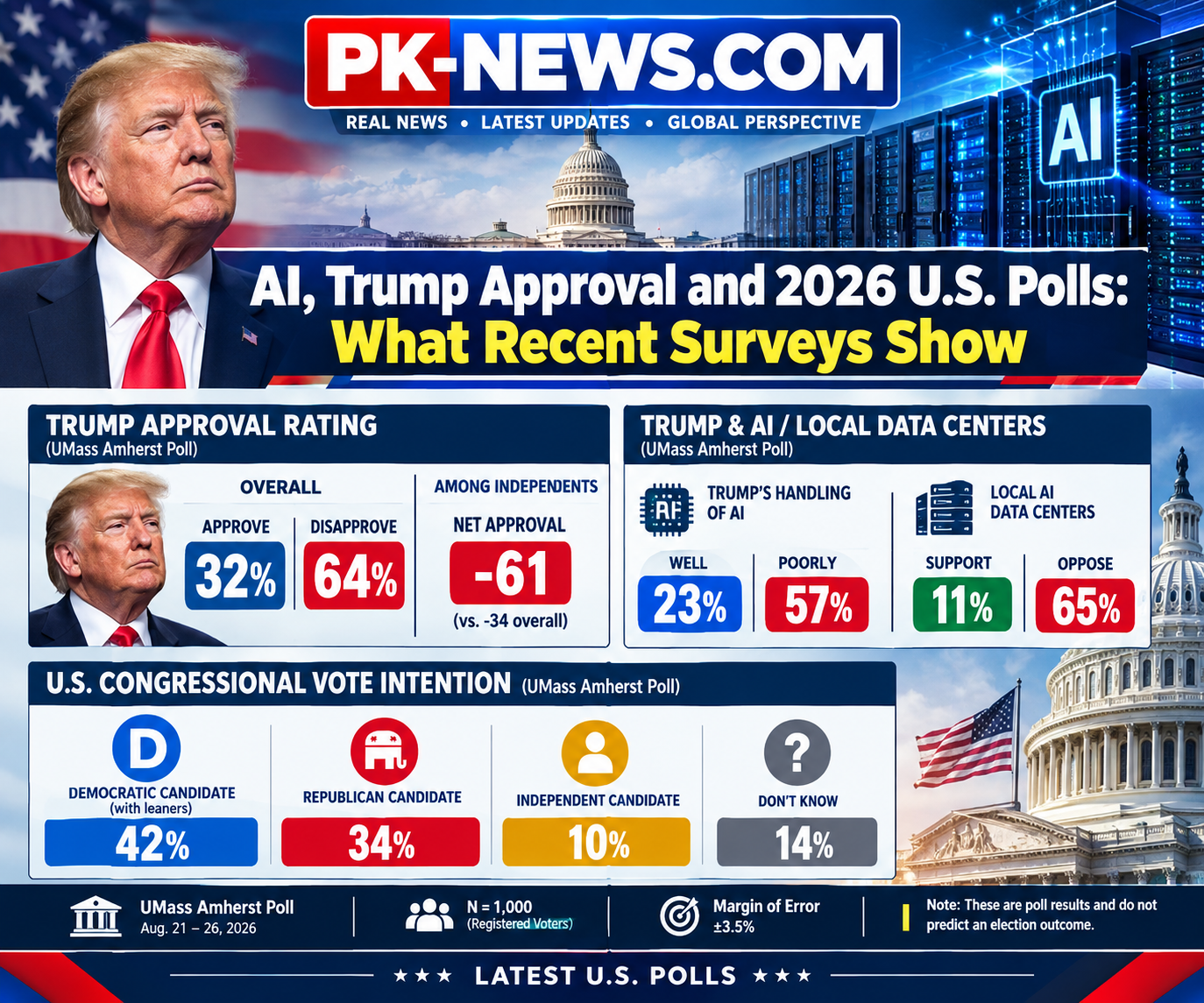
The political landscape in the United States is showing several important shifts as the country moves toward the 2026 midterm elections. New polling and political analysis point to growing public concern about artificial intelligence, continuing challenges for President Donald Trump and a changing balance between Republicans and Democrats among voters.
The developments come at a time when economic concerns, the cost of living, foreign policy and the rapid growth of artificial intelligence are increasingly shaping the national political conversation.
A recent New York Times/Siena survey conducted from September 8 through September 13 among 1,503 likely voters found that President Donald Trump had a 38% job approval rating. The survey also found Democratic congressional candidates leading Republican candidates by close to nine percentage points among likely voters when respondents were asked about their preferred candidate in their congressional district.
However, the polling does not determine what will happen in November. National polling can show the overall political environment, but congressional elections are decided in individual districts and states, where local candidates, turnout, campaign spending and other factors can have a major impact.
Growing Questions Around Artificial Intelligence
Artificial intelligence has quickly become one of the most important technology and policy issues in the United States.
AI systems are being integrated into workplaces, education, healthcare, government services and consumer products. At the same time, concerns remain about job displacement, misinformation, privacy, security and the possibility that increasingly powerful AI systems could create risks that existing regulations do not adequately address.
Recent political discussions have therefore increasingly focused on how quickly AI should develop and what role the government should play in regulating the technology.
The Times/Siena polling found that voters were closely divided on which political party they trusted more to handle artificial intelligence. Among respondents who answered that question, Republicans held a narrow advantage, while a significant portion of respondents were uncertain.
That uncertainty is significant because AI has not historically been one of the central issues determining U.S. elections. As the technology becomes more visible in everyday life, however, candidates and political parties are increasingly being forced to explain how they would approach AI regulation and innovation.
Trump Faces Pressure Over the Economy and Cost of Living
Economic conditions remain one of the biggest issues facing the Trump administration.
The latest Times/Siena poll found that voters expressed substantial dissatisfaction with the president's handling of the economy and cost-of-living pressures. Only a minority of respondents said they approved of Trump's handling of affordability, while a large majority disapproved.
The cost of living has become particularly important for voters who are dealing with housing expenses, food prices, transportation costs and other household bills.
The survey also found that only 14% of voters believed the economy was better than it had been a year earlier, compared with a considerably larger share earlier in the year. Among Republican voters, the percentage saying the economy was better had also fallen substantially compared with January.
These numbers help explain why economic conditions are playing such a central role in the political debate.
For the Trump administration, the challenge is not limited to persuading Democratic voters. The polling indicates that some Republican and independent voters are also expressing concerns about economic conditions.
Democrats Show Strength in Congressional Polling
The latest national survey also showed Democrats gaining ground in the congressional preference question.
Among likely voters, Democratic congressional candidates were favored by close to nine percentage points over Republican candidates in the survey. The poll also found that independent voters were more likely to support Democratic congressional candidates than Republican candidates.
Younger voters were another important group in the survey. Voters under 30 showed a substantial Democratic preference, while Hispanic voters also showed a stronger Democratic preference than in some previous political contests.
The figures are notable because Democrats had experienced losses among several of these groups during the 2024 presidential election.
However, polling should not be treated as a prediction of the final election result.
The congressional map is made up of individual races with different candidates and political environments. Some districts are highly competitive, while others are relatively safe for one party. Senate elections are similarly dependent on individual states rather than the national vote.
Trump’s Approval Remains a Major Political Factor
Trump's overall approval rating is another major part of the current political environment.
In the latest Times/Siena survey, 38% of likely voters approved of Trump's job performance, while a majority disapproved. The survey also found particularly low approval among younger voters and independent voters.
Trump's political standing is important because Republican candidates in competitive congressional races must decide how closely they want to associate themselves with the president.
The poll found that voters were also concerned about the possibility of Republicans in Congress allowing Trump to go too far, while another group expressed concern about Democrats moving too far to the left.
That indicates that voters are not simply divided into two completely uniform political camps. Many respondents expressed concerns about both parties, while others focused primarily on economic and national issues.
The Cost of Living Could Remain a Central Election Issue
Among all the issues measured in the survey, economic concerns stood out.
The poll found that 71% of voters disapproved of Trump's handling of the cost of living, compared with 28% who approved.
Affordability has become a particularly important issue because voters experience economic conditions directly through household expenses.
Even when broader economic indicators show growth or other positive developments, voters may judge the economy based on whether their own income is keeping pace with rent, mortgages, food, energy and other expenses.
This creates a difficult political environment for both parties.
Republicans can point to their economic policies and argue that their approach will improve growth and investment, while Democrats can focus on household affordability and the economic pressure experienced by many voters.
AI Could Become a Larger Political Issue
Artificial intelligence adds another dimension to the political debate.
The United States remains one of the world's major centers for AI development, with technology companies investing heavily in data centers, computing infrastructure and new AI systems.
Supporters of rapid AI development argue that the technology could increase productivity, create new industries and strengthen America's technological position.
Critics and researchers have raised questions about employment disruption, misinformation, cybersecurity, privacy and the potential risks of increasingly autonomous systems.
Political leaders are therefore facing a difficult policy question: how can the United States encourage technological innovation while addressing risks that may emerge from increasingly powerful AI systems?
The latest polling suggests voters are still developing their views on this issue. That leaves room for AI policy to become more important as candidates explain their positions during the election campaign.
Why the Latest Numbers Matter
The combination of economic dissatisfaction, Trump's approval rating and Democratic strength in national congressional polling creates an important political environment heading toward the midterms.
But the numbers should be interpreted carefully.
A national poll does not determine which party will control Congress. House elections are decided in individual districts, while Senate control depends on individual statewide contests.
The New York Times/Siena survey itself notes that the national political environment does not guarantee that either party will win specific competitive Senate races or gain control of Congress.
Polling can change as campaigns develop, candidates receive greater public attention and voters make their final decisions.
What Voters May Be Watching Next
Several issues are likely to remain important as the 2026 midterm campaign continues:
The cost of living and household affordability
Employment and economic growth
President Trump's approval rating
Immigration policy
Foreign conflicts and U.S. military involvement
Artificial intelligence regulation and development
Healthcare costs
Congressional control
Candidate quality and local campaign issues
For voters, the next several weeks could provide additional information about how these issues are affecting individual congressional races.
The Bigger Picture
The latest political data show a U.S. electorate focused heavily on economic conditions while also becoming increasingly interested in emerging issues such as artificial intelligence.
Trump remains a central figure in the political debate, and his approval numbers are closely connected to the environment facing Republican congressional candidates. At the same time, Democrats have demonstrated stronger numbers in recent national congressional polling.
But the election remains a collection of individual contests rather than a single national vote.
For now, the most significant development is not one particular poll number but the combination of several trends: economic concerns remain high, voters continue to debate the direction of the country, AI is becoming a more visible policy issue, and both major parties face challenges in persuading undecided and independent voters.
As the 2026 midterm elections approach, these issues will continue to shape the political conversation across the United States.
Source: New York Times/Siena national polling, September 8–13, 2026. The survey interviewed 1,503 likely voters and reported a margin of sampling error of approximately ±2.9 percentage points.
Published by: PK News
Author: Muhammad Ibraheem
Related Articles You May Like
Related News










Comments (0)
Leave a Comment
No comments yet. Be the first to comment!